When do we plan for barriers?
When we plan an inquiry, most of our energy goes into the central idea and the provocation that will spark curiosity. Support for individual learners is usually added later, once a student is visibly struggling.
Universal Design for Learning (UDL) asks us to reverse that order. CAST’s UDL Guidelines locate barriers in the design of the lesson and the learning environment, which means many of them can be predicted and planned for ahead of teaching.
Todd Rose makes a similar point in The End of Average. Every learner has a jagged profile of strengths and needs, so a unit designed for an imagined average student, who might not exist, fits some learners well and leaves many not included.
Before a unit starts, I ask one question: where are students likely to get stuck? Reading, open-ended tasks, group dynamics, and the length of the investigation are all predictable. When we identify these barriers early, we can design choices from the start and spend less time adding fixes for individual students later.
How can inquiry create barriers?
Inquiry relies on features we value: questions, extended investigations, talk, and the courage to share ideas still taking shape. For most learners, these features are an invitation. For some learners, the same features can become the obstacle. A student who freezes in front of a blank wonder wall is responding to the design of the task, and the design is something we can develop to respond to the needs of the students.
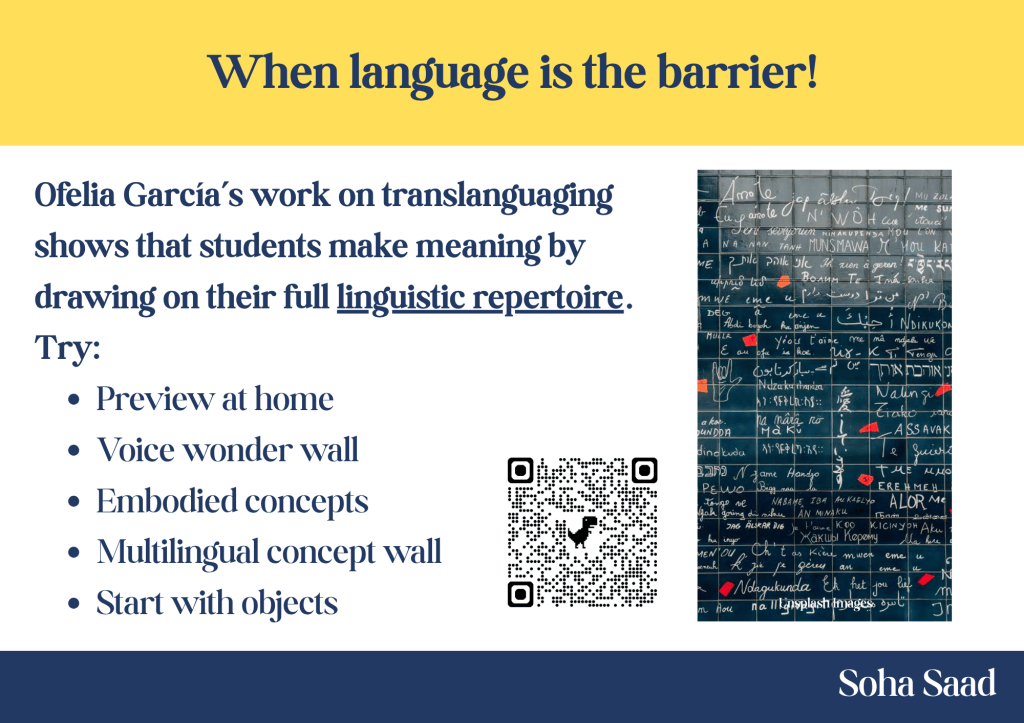
When language is the barrier!
Much of the inquiry work we plan for depends on reading sources, writing questions, and explaining thinking in words. When the language of instruction is not a student’s strongest language, or when reading and writing are hard for them, their thinking is hidden behind the words, and we end up assessing their language in place of their understanding. Ofelia García’s work on translanguaging shows that multilingual students make meaning by drawing on their full linguistic repertoire, and classrooms that welcome every language give students more entry points into complex ideas.
- Preview at home: Send the provocation home the day before, as a photo or short video, so families can talk about it in their home language.
- Voice wonder wall: Students record their questions as audio clips or QR codes, so the speed of their writing no longer limits how many questions they can ask.
- Embodied concepts: Agree on a visual, gesture, or object for the concepts you are exploring. This allows students to show their understanding of a concept before they have the vocabulary to explain it.
- Multilingual concept wall: Students collect the concept word in every language spoken in the class, then compare the meanings. Translating becomes a way they explore how different cultures think about and communicate their understanding.
- Start with objects: The first round of sharing is done only through drawings or objects, and words come in the second round.
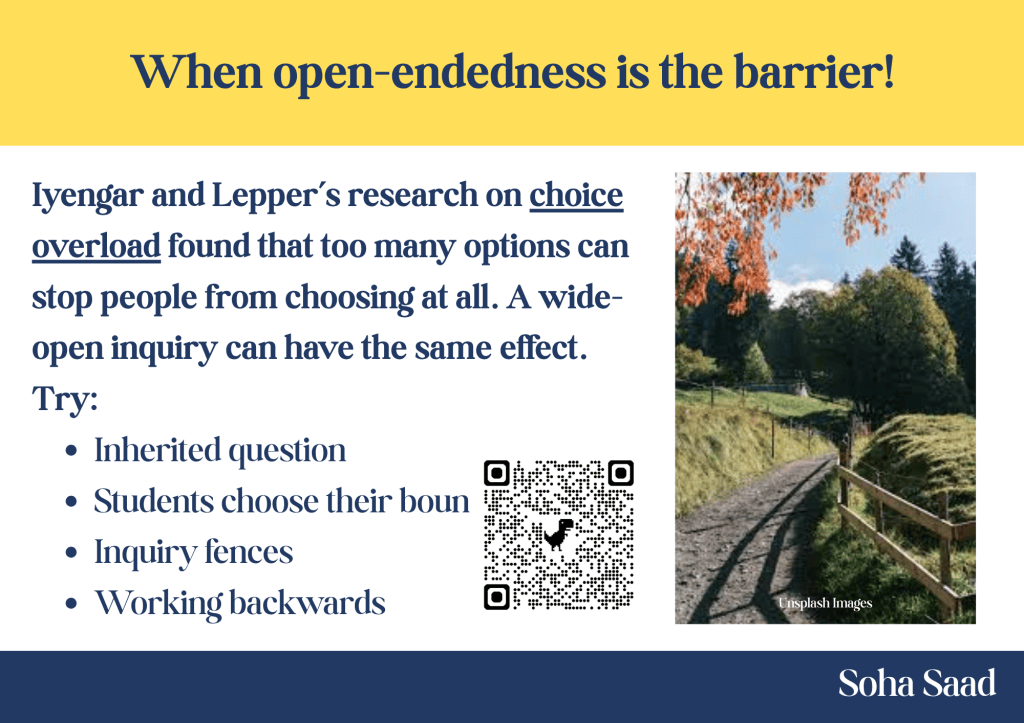
When open-endedness is the barrier!
Inquiry frequently begins with “What do you wonder?” For many students, that much freedom feels like a blank page. Without clear boundaries or a sense of where to start, they freeze, wander, or wait for someone else to lead. Iyengar and Lepper’s research on choice overload found that people offered a large range of options were less likely to choose at all, and a wide-open inquiry task can have the same effect on learners.
- Inherited question: Students start by improving a question left behind by last year’s class, so they don’t begin from scratch.
- Inquiry fences: Set a clear boundary for the exploration. A boundary gives students a place to begin, and the inquiry can open up once they have found their footing.
- Working backwards: Show a finished product or outcome first. Students inquire backwards into how and why it was created and what problem it solves.
- Curated choice: Offer two or three options in place of a long menu. A smaller set keeps the value of choice while reducing the decision load, which matters for students who experience anxiety or attention difficulties.
- Contrast examples: Show a thin question beside a thick question and ask students to explain the difference. Students build their own criteria for a good question, which makes the next open task far less daunting.
- Allow students to choose their boundary: Create boundary cards and give the students the opportunity to set their own boundary, so each learner decides how much openness they can handle and develops their ability to self-regulate and self-adjust.
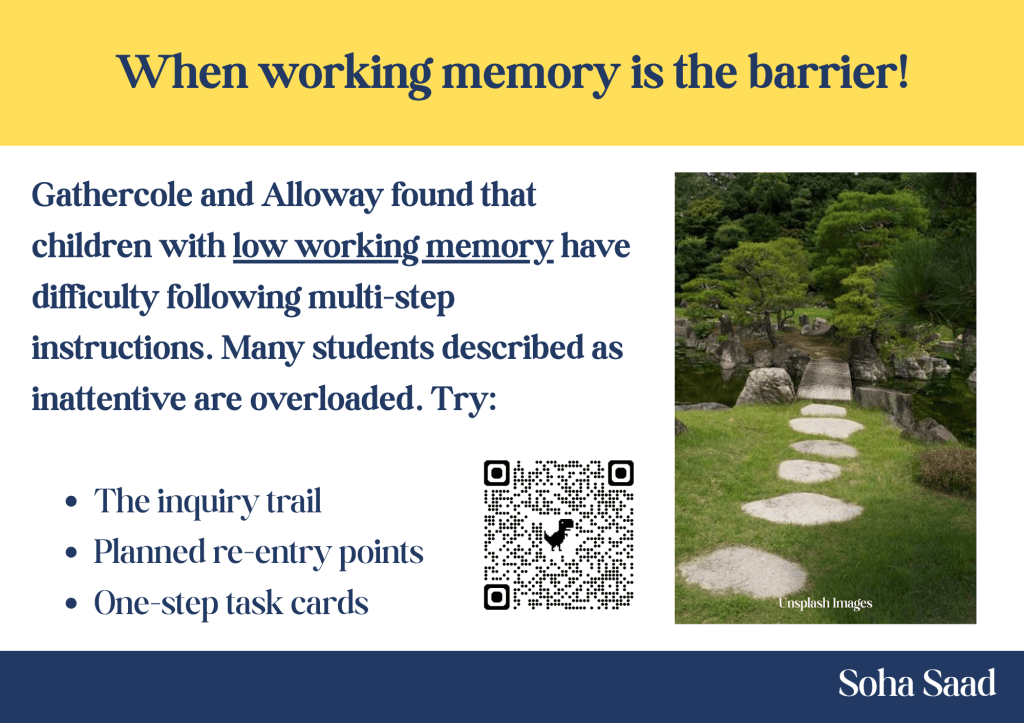
When working memory is the barrier!
Inquiry runs over weeks and asks students to hold questions, findings and next steps in mind at once. Students who struggle to plan, organise or remember earlier steps can’t always keep track. Gathercole and Alloway’s research on working memory found that children with low working memory have difficulty following multi-step instructions and keeping track of where they are in a task. Teachers commonly describe these children as inattentive, when many of them are overloaded.
- The inquiry trail: Keep a wall or shared slide that records each step of the inquiry with a photo, an artefact, or the question the class explored that day. The trail works as external memory for the whole class and lets a student who was absent catch up independently.
- Planned re-entry points: Build re-entry points into longer units, such as a short “Where are we now?” learning engagement every few lessons.
- One-step task cards: Break a multi-step research task into separate cards so students see only the step in front of them. When they finish, they turn the card over and pick up the next one.
How can students help us design for inclusive inquiry?
The barriers we predict at the start of a unit are our best informed guess, and students can tell us where the barriers turned out to be. Ending lessons with two questions brings those barriers into view: What got in your way today? What would have helped? Over time, students become co-designers of their learning, and the barriers we plan for become grounded in what students have identified as learning barriers.



Leave a Reply