Most coordinators and middle leaders eventually reach a moment when you look at where the school’s time, energy, and resources are going, and it isn’t where you would put them. Learning feels a step further from the centre than it should be.
That moment rarely means colleagues don’t care about learning. Leaders sit in different seats. One sees budgets and enrolment, another staffing and wellbeing, another families and the wider community. Each is working to support learning from a different angle.
The question, then, is not who is right. It is how to build a shared direction when people see the same goal from different angles. Here are four ideas from leadership and organisational research that can help.
1. Get on the balcony
Theory:
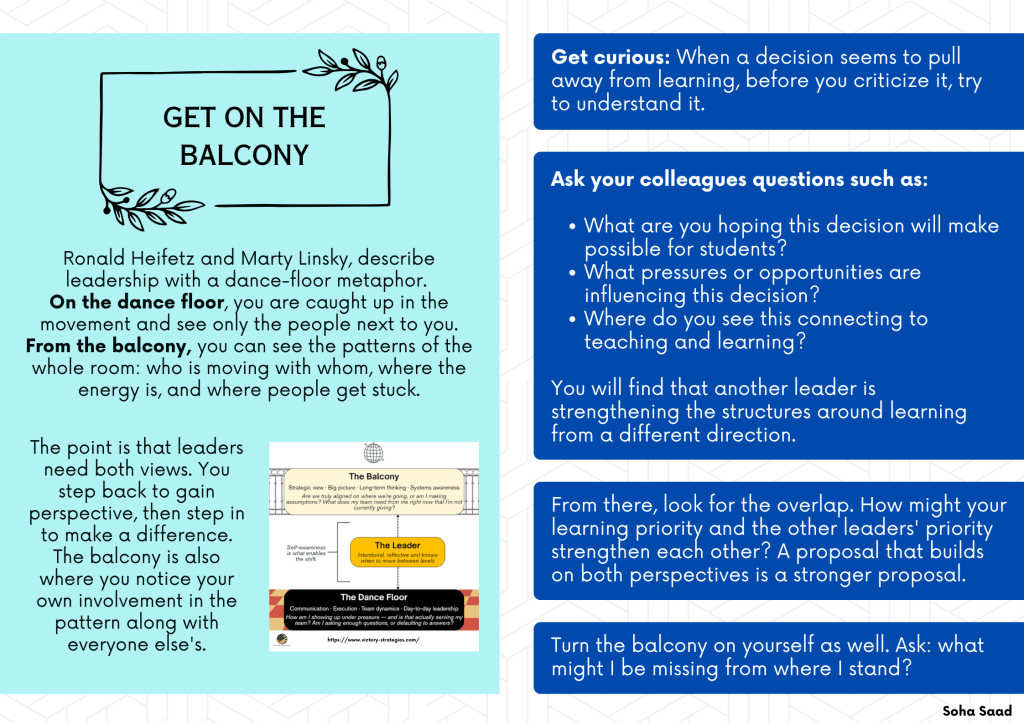
Ronald Heifetz and Marty Linsky, in Leadership on the Line, describe leadership with a dance-floor metaphor. On the dance floor, you are caught up in the movement and see only the people next to you. From the balcony, you can see the patterns of the whole room: who is moving with whom, where the energy is, and where people get stuck.
The point is that leaders need both views. You step back to gain perspective, then step in to make a difference. The balcony is also where you notice your own involvement in the pattern along with everyone else’s.
Strategy:
Get curious! When a decision seems to pull away from learning, before you criticize it, try to understand it. Ask your colleagues questions such as:
- What are you hoping this decision will make possible for students?
- What pressures or opportunities are influencing this decision?
- Where do you see this connecting to teaching and learning?
You will find that another leader is strengthening the structures around learning from a different direction. Timetables, staffing, wellbeing, finances, partnerships and community trust are all conditions that make good learning possible.
From there, look for the overlap. How might your learning priority and the other leaders’ priority strengthen each other? A proposal that builds on both perspectives is a stronger proposal.
Turn the balcony on yourself as well. Ask: what might I be missing from where I stand?
2. Do we walk the talk?
Theory:
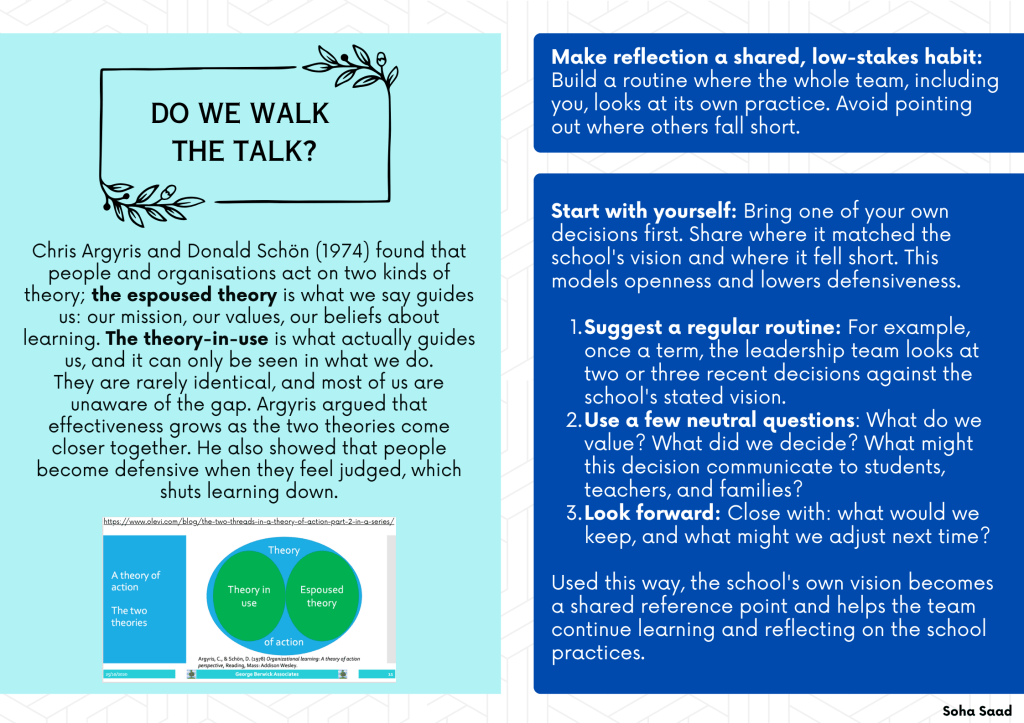
Chris Argyris and Donald Schön, in Theory in Practice (1974), found that people and organisations act on two kinds of theory:
The espoused theory is what we say guides us: our mission, our values, our beliefs about learning.
The theory-in-use is what actually guides us, and it can only be seen in what we do.
They are rarely identical, and most of us are unaware of the gap. Argyris argued that effectiveness grows as the two theories come closer together. He also showed that people become defensive when they feel judged, which shuts learning down.
Strategy:
Make reflection a shared, low-stakes habit! Build a routine where the whole team, including you, looks at its own practice. Avoid pointing out where others fall short.
Start with yourself! Bring one of your own decisions first. Share where it matched the school’s vision and where it fell short. This models openness and lowers defensiveness.
- Suggest a regular routine: For example, once a term, the leadership team looks at two or three recent decisions against the school’s stated vision.
- Use a few neutral questions: What do we value? What did we decide? What might this decision communicate to students, teachers, and families?
- Look forward: Close with: what would we keep, and what might we adjust next time?
Used this way, the school’s own vision becomes a shared reference point and helps the team continue learning and reflecting on the school practices.
3. Let learning evidence influence decisions
Theory:
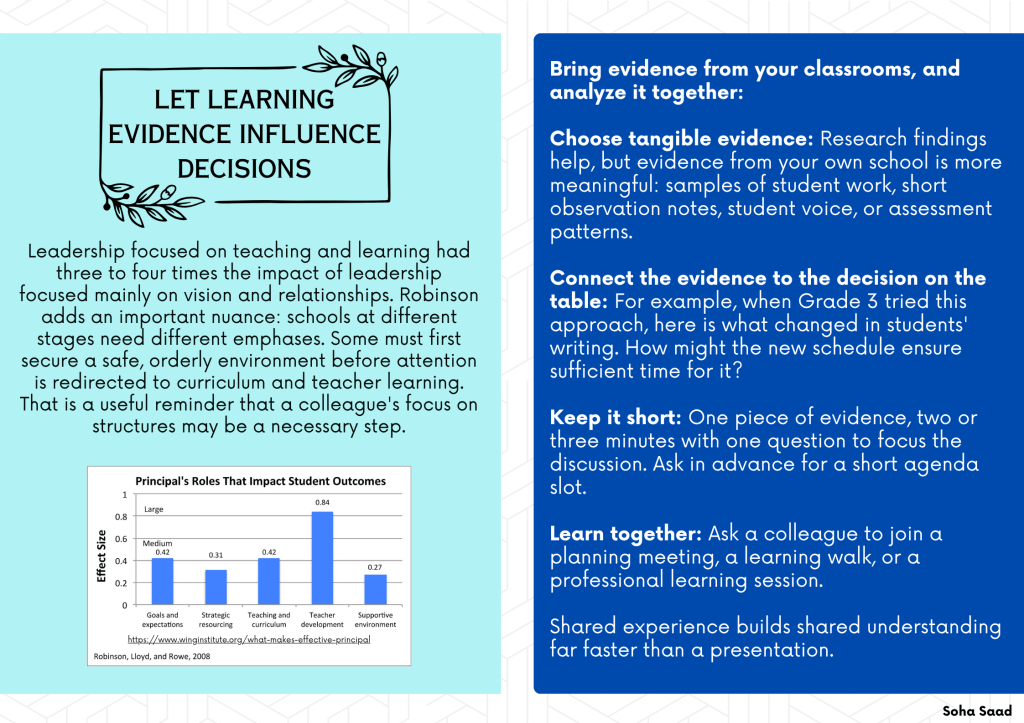
In 2008, Viviane Robinson, Claire Lloyd and Kenneth Rowe combined the findings of 27 published studies on school leadership and student outcomes. They compared different kinds of leadership and grouped leadership practices into five dimensions.
They measured impact using effect sizes. An effect size is a standard way to express how strongly one thing is linked to another, so results from different studies can be compared. In their review, anything above 0.6 counted as a large effect.
The effect size of leaders promoting and taking part in teacher learning and development is 0.84. The key word is participating. These leaders fund or organise professional learning; more importantly, they learned alongside teachers.
The review also found that leadership focused on teaching and learning had three to four times the impact of leadership focused mainly on vision and relationships. Robinson adds an important nuance: schools at different stages need different emphases. Some must first secure a safe, orderly environment before attention is redirected to curriculum and teacher learning. That is a useful reminder that a colleague’s focus on structures may be a necessary step.
Strategy
Bring evidence from your classrooms, and analyze it together:
- Choose tangible evidence: Research findings help, but evidence from your own school is more meaningful: samples of student work, short observation notes, student voice, or assessment patterns.
- Connect the evidence to the decision on the table: For example, when Grade 3 tried this approach, here is what changed in students’ writing. How might the new schedule ensure sufficient time for it?
- Keep it short: One piece of evidence, two or three minutes with one question to focus the discussion. Ask in advance for a short agenda slot.
- Learn together: This is the heart of Robinson’s finding. Ask a colleague to join a planning meeting, a learning walk, or a professional learning session. Shared experience builds shared understanding faster than a presentation.
4. Build coherence, not just alignment
Theory:
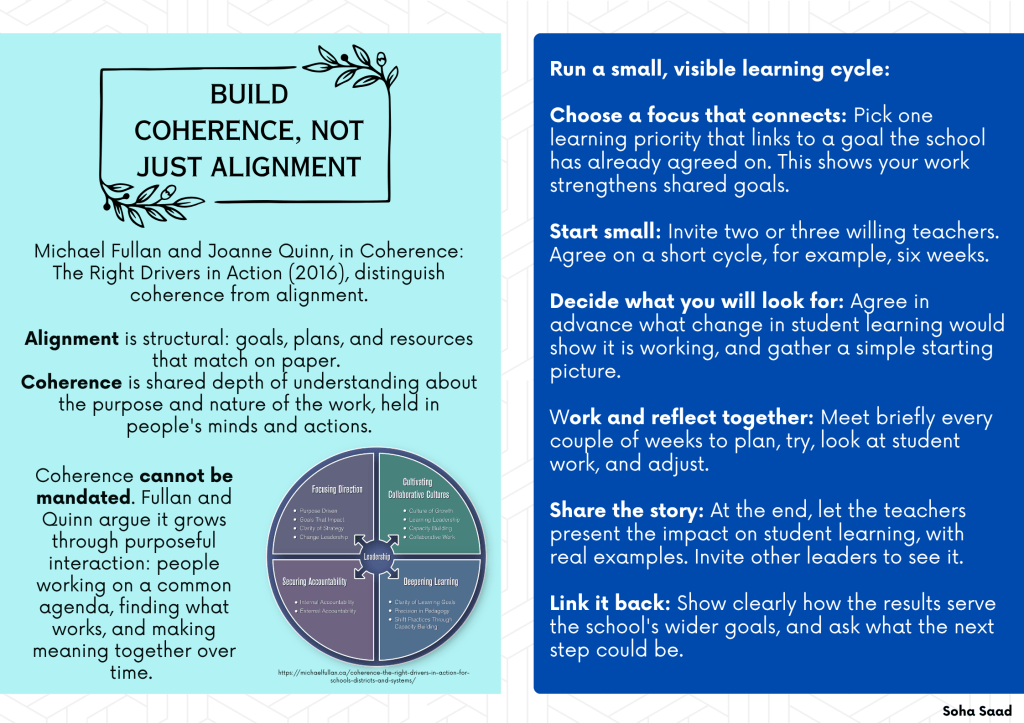
Michael Fullan and Joanne Quinn, in Coherence: The Right Drivers in Action (2016), distinguish coherence from alignment.
Alignment is structural: goals, plans, and resources that match on paper.
Coherence is shared depth of understanding about the purpose and nature of the work, held in people’s minds and actions.
Coherence cannot be mandated. Fullan and Quinn argue it grows through purposeful interaction: people working on a common agenda, finding what works, and making meaning together over time. Fullan also writes about leadership from the middle. Middle leaders become stronger partners in every direction: with teachers, with peers, and with senior leaders.
Strategy:
Run a small, visible learning cycle:
- Choose a focus that connects: Pick one learning priority that links to a goal the school has already agreed on. This shows your work strengthens shared goals.
- Start small: Invite two or three willing teachers. Agree on a short cycle, for example, six weeks.
- Decide what you will look for: Agree in advance what change in student learning would show it is working, and gather a simple starting picture.
- Work and reflect together: Meet briefly every couple of weeks to plan, try, look at student work, and adjust.
- Share the story: At the end, let the teachers present the impact on student learning, with real examples. Invite other leaders to see it.
- Link it back: Show clearly how the results serve the school’s wider goals, and ask what the next step could be.
Different routes, shared destination
Seeing learning differently from your colleagues doesn’t mean something is wrong with your team. Often, it is what a healthy leadership team looks like: people holding different parts of the same purpose.
The coordinator’s contribution is to keep learning visible in every conversation, through curiosity, shared reflection, evidence, small wins and constructive voice. None of these require winning an argument. All of them build a team that understands learning more deeply together.
Which of these have you tried? What has helped you stay true to learning while building bridges with colleagues?
References
- Argyris, C., & Schön, D. A. (1974). Theory in practice: Increasing professional effectiveness. Jossey-Bass. Overview: infed.org
- Fullan, M., & Quinn, J. (2016). Coherence: The right drivers in action for schools, districts, and systems. Corwin. Overview: Coherence book study
- Heifetz, R. A., & Linsky, M. (2002). Leadership on the line: Staying alive through the dangers of leading. Harvard Business School Press.
- Hirschman, A. O. (1970). Exit, voice, and loyalty: Responses to decline in firms, organizations, and states. Harvard University Press.
- Robinson, V. M. J., Lloyd, C. A., & Rowe, K. J. (2008). The impact of leadership on student outcomes: An analysis of the differential effects of leadership types. Educational Administration Quarterly, 44(5), 635–674. PDF



Leave a Reply