
In science teaching, it can be easy to get caught up in covering facts and topics or practicing isolated skills. But what if we shifted the focus to something deeper? Conceptual Learning helps students organize what they learned, connect ideas, and transfer their understanding to unfamiliar situations. When we teach science conceptually, we’re not just teaching students about science, we’re teaching them how to think like scientists. Isn’t this the true aim of science education?
The IB Primary Years Programme (IB PYP) recently published the Science Subject Overview to support educators in achieving exactly that. The overview clarifies what science learners should be able to do and how educators can effectively support them. By clearly defining the roles of students and teachers, providing examples of learning outcomes, and highlighting how additional science-specific concepts support deeper conceptual understanding, the overview acts as a guide to enhance our teaching practices and students’ learning experiences.
Here is a visual to break down the PYP science subject overview 2025 and how it supports conceptual learning:
Science Knowledge and Skills
The Science Learner and The Science Educator in The PYP
When we think about teaching science conceptually, it’s important that we clearly see our role as educators reflected in what our students are learning. The PYP Science Subject Overview explicitly describes what it means to be a science learner and educator, and it’s valuable for us as teachers to see these roles aligned. The table below uses the IB’s own language to show how our practices as educators support and align with what our students should be capable of as scientists.
| The Science Learner | The Science Educator |
|---|---|
| engage in hands-on learning experiences to foster scientific inquiry and questioning | Provide opportunities to support students to engage in their own inquiries |
| express wonderings | Guide students to formulate their own questions |
| select and use appropriate tools to measure data accurately | Design learning experiences and assessments that are inclusive for diverse students, and provide access to a variety of external resources and settings |
| use scientific vocabulary to explain their observations and experiences | Model scientific language |
| embrace uncertainty and ambiguity | Promote learner reflection and action in response to their learning |
| engage in discussions, dialogue, and data interpretation | Build connections between students’ experiences and the information and processes obtained from the inquiry into new understandings |
| propose scientific explanations to justify hypotheses | Model scientific language, Guide students to formulate their own questions |
| understand multiple perspectives in science, and consider applications for them | Collaborate with classroom educators and other single-subject educators, to plan and develop central ideas, incorporating their input |
| play, participate, experiment and iterate in scaffolded, guided and independent investigations | Provide opportunities to support students to engage in their own inquiries, Design learning experiences and assessments that are inclusive for diverse students |
| work both individually and collectively | Collaborate with classroom educators and other single-subject educators, to plan and develop central ideas, incorporating their input, Provide opportunities to support students |
| make informed choices | Promote learner reflection and action in response to their learning |

Example Learning Outcomes (Knowledge & Skills)
The Science Subject Continuum is organized around three strands:
- Living Things
- Earth & Space
- Physical and Chemical Science

The new continuum includes clear, practical example learning outcomes. These help us as teachers define precisely what we want our students to learn. From these examples, we can identify the skills students should develop and the specific topics and facts they need to learn. Let’s look at an example using the strand “Physical and chemical science,” specifically focusing on the topic of Materials and Matter.
Lets look at these learning outcomes from the physical and chemical strand:
Phase 1
- Identify common materials and their use in daily life.
- Identify the properties of materials.
- Gather, compare, sort, classify, order, interpret and describe observable characteristics and properties.
- Observe patterns and draw conclusions.
Phase 2
- Describe matter as everything that has mass and occupies volume.
- Investigate how liquids and solids respond to changes in temperature, for example, water changing to ice, or melting chocolate.
Clearly identified knowledge and skills from these outcomes:
| Knowledge (Topics and Facts) | Skills |
|---|---|
| – Names and uses of common materials (wood, plastic, metal, fabric) – Observable properties of materials (texture, hardness, flexibility) – Solids, liquids, and gases (matter definition: mass & volume) – Effect of temperature changes on materials (water freezing, chocolate melting) – Changing states of matter | – Identification and classification – Observation and comparison – Gathering, interpreting, and describing data – Investigating through hands-on experimentation |

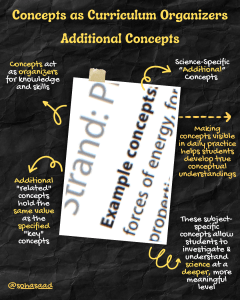
Concepts as Curriculum Organizers
The knowledge and skills we identify in our units form the foundation that students need to understand concepts and articulate clear conceptual understandings. Concepts act as organizers for knowledge and skills; therefore, concepts cannot be truly grasped if students haven’t had opportunities to build knowledge and skills, recognize patterns, and make connections.
It is equally important to highlight that the additional “subject-specific” concepts (previously called related concepts) hold the same value as the specified “key” concepts. These subject-specific concepts allow students to investigate science at a deeper and more meaningful level. The PYP Science Subject Continuum explicitly provides examples of these science-specific concepts to support you in your daily teaching. Making these additional subject-specific concepts visible and explicit in your everyday learning engagements enriches students’ understanding and inquiry.

To clearly identify your subject-specific concepts, examine the topics and skills you have identified. For example, based on the previous learning outcomes about materials and matter:
Knowledge & Topics:
- Common materials and their properties (texture, hardness, flexibility)
- States of matter (solids, liquids)
- Mass and volume
- Effects of temperature on materials (melting, freezing)
Skills:
- Identification and classification
- Observation and comparison
- Investigation through hands-on experimentation
- Recognizing patterns and drawing conclusions
By closely analyzing these, you can draw out subject-specific concepts like:
- Properties
- Matter
- Materials
- States (of matter)
- Classification
- Change
These additional subject-specific concepts should be explicitly integrated into your daily engagements, investigations, and student discussions to support deeper conceptual understanding.
Developing Conceptual Understandings
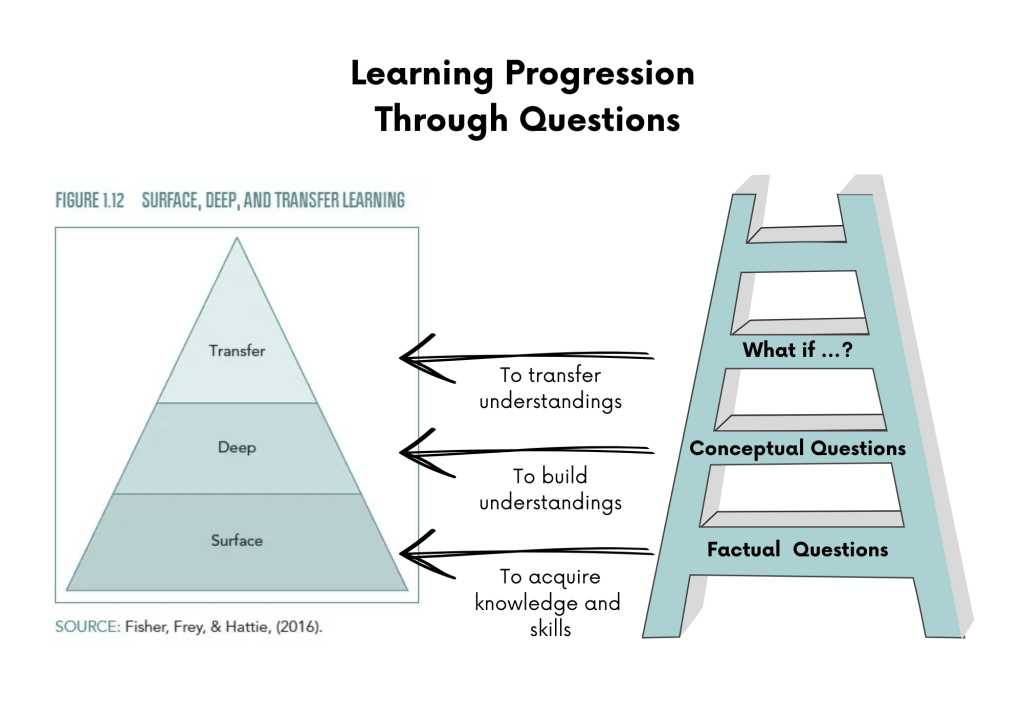
For students to develop conceptual understandings, they need explicit opportunities to explore how different concepts connect. It’s through exploring factual examples, case studies, and scenarios that students see clearly how concepts relate to each other and form a deeper understanding.
Understanding Skills
As educators, we must be intentional in teaching scientific skills explicitly. For example, if we want our students to ask questions that can be investigated through experiments, we need to explicitly teach them:
- What a testable question is.
- How to ask a clear, testable question.
- Why we ask questions that can be tested experimentally.
- How and why to plan and carry out an experiment clearly and systematically.
We cannot assume our students automatically know these skills or will pick them up from observing just one experiment. Students need opportunities to participate in multiple experiments, guiding them to reflect on why and how experiments help us answer our scientific questions.
Classroom Example:
Students might investigate several different experiments involving the changing states of matter, like melting ice, freezing juice, or melting chocolate. Before each investigation, the class explicitly discusses how to frame a clear, testable question (for example, “How long does it take for different types of chocolate to melt?” or “Does adding salt to water change how quickly it freezes?”). Students learn explicitly to plan each experiment, clearly define what they are observing and measuring, and reflect on why each step matters. Through repeated experiences, students deeply understand the why and how of asking testable questions and conducting methodical experiments.
Understanding Knowledge
To help students articulate conceptual understandings, they must investigate factual examples or scenarios and explicitly connect these to concepts.
In a unit exploring matter, students might first investigate specific factual examples, such as examining everyday objects (a wooden spoon, plastic bottle, metal keys, rubber eraser), investigating and describing their observable properties. As they study these items, students explicitly connect their observations to concepts like properties, classification, and materials. They might then explore scenarios involving temperature changes—freezing water into ice, melting chocolate, or butter melting when heated—to connect to the concept of change.
By explicitly exploring a range of factual examples and scenarios, students learn to recognize and articulate clear connections between concepts, developing deeper conceptual understandings of materials, matter, and change.
Teaching science conceptually means being intentional about the knowledge, skills, and concepts we make visible to students. When we plan with clarity and purpose, we create learning experiences that not only build understanding but help students think and act like scientists. The PYP Science Subject Overview is a valuable tool to guide this work and deepen our impact in the classroom.
Looking to go deeper with this in your school? I offer coaching and workshops for teams and curriculum leaders. [Learn more here.]



 The Organized Chaos In The PYP Classroom
Leave a reply to aggiekesler Cancel reply