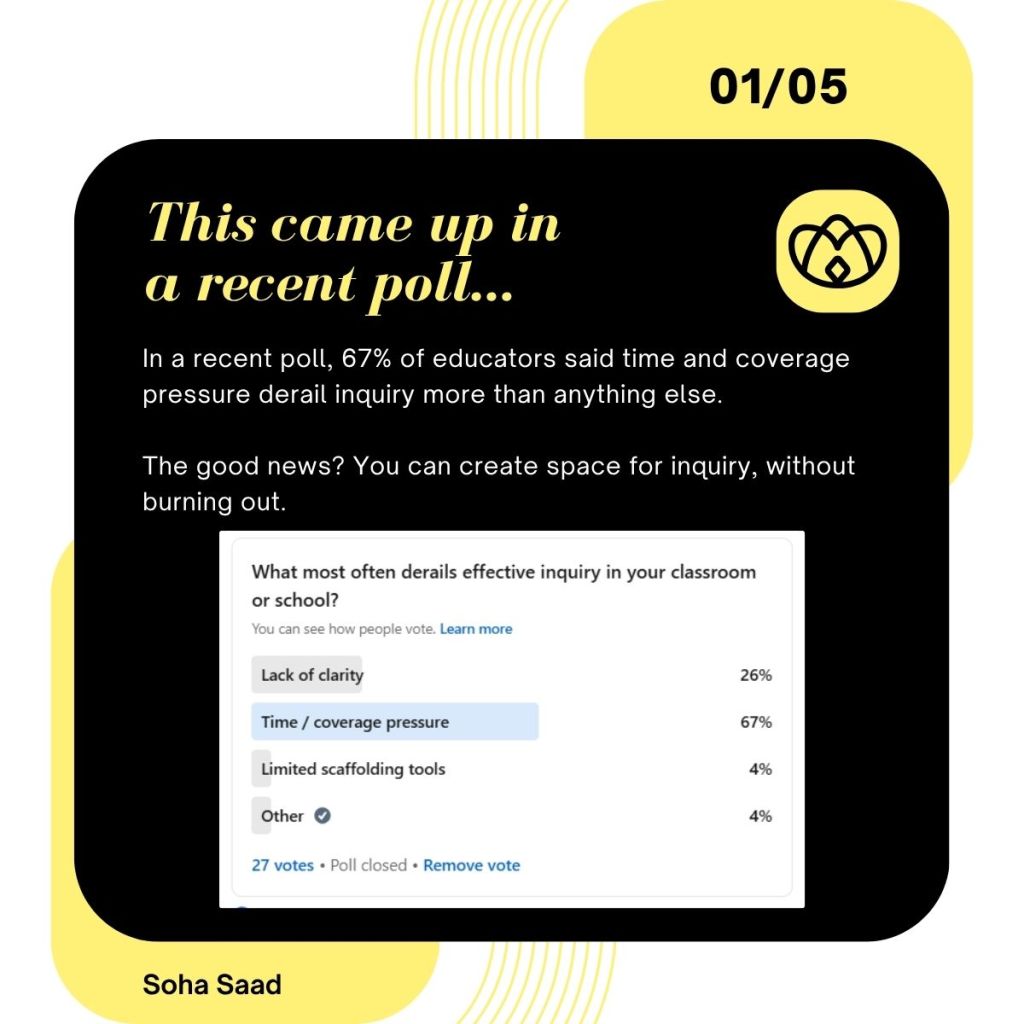
This question came up in the comments and poll of my recent LinkedIn post and it’s a real, daily challenge for many teachers. It’s not that we don’t believe in the value of inquiry. We do. But we’re trying to make it work inside a system that might not designed for depth.
📊 View the original LinkedIn poll
Here are a few moves that might help. They’re not magic fixes, but they are real, doable moves that can create breathing space.
Reframe Coverage as Conceptual Depth
The goal isn’t to “get through everything.” It’s to help students make sense of what matters most.
Instead of racing through content, identify 2–4 conceptual understandings or transfer goals that anchor the unit. Let those guide which facts, skills, and experiences are worth investing in.
✅ Tip: Use conceptual understandings and guiding questions to cut through content overload. They give focus without limiting curiosity.

Start with Conceptual Clarity
Backward design is a time-saver. When you know exactly what students should understand, know and do, you can strip away the clutter. You don’t need more lessons. You need the right ones.
✅ Tip: 5-9 well-crafted conceptual understandings per unit are enough. Let those guide your choices, not the textbook index.

Ruthlessly Trim “Coverage”
Not everything deserves equal time. We often teach more than students can remember and far more than they need to truly understand the big ideas.
- Bundle standards around an essential question. One strong inquiry can address multiple standards. No need to teach each one in isolation.
- Delete or delegate the trivia. Ask: Will this fact resurface later or support a conceptual understanding? If not, drop it or move it to homework.
✅ Bottom line: If everything is “essential,” nothing is. Making a “do-not-teach” list is sometimes the most strategic planning move we can make.

Make Routines Work for You
You don’t need a brand-new strategy every time. One of the best ways to create space for inquiry is to make some parts of your day predictable, for you and your students.
Start by choosing just 1 or 2 parts of your week to routinize. Not because inquiry should feel repetitive but because structure frees up cognitive space, when students know what to expect, they take more risks.
Try this instead:
- Use visible routines for thinking. Whether it’s a reflection prompt, “turn and talk” protocol, or sentence starter wall, choose a few that travel across subjects and stick with them.
- Teach how to use tools, not just what tools. Want students to record research notes, document thinking, or peer-assess? Don’t re-teach the tool each time. Model it once, then revisit in context until it becomes second nature.
- Keep transitions tight. Teach students how to move between activities. A class that knows how to switch gears smoothly gives you back 5–10 minutes a day. That’s inquiry time.
✅ Tip: Repetition isn’t the enemy of inquiry, it’s what gives students the confidence to take intellectual risks.



 The Organized Chaos In The PYP Classroom
Leave a Reply