In today’s digital age, knowledge is at our fingertips. With a quick Google search or even by asking AI, students can instantly find answers to almost any question. But if answers are so readily available, what does that mean for learning? This challenges us to reconsider traditional, teacher-centered approaches. When answers are a click away, the real skill lies in asking the right questions. That’s where inquiry-based learning comes in. This pedagogical approach shifts the focus from simply finding answers to exploring questions, encouraging a deeper understanding of the subject matter.
What Is Inquiry?
Harvard’s Project Zero describes inquiry-based learning as “the process of addressing a driving question or challenge that requires the learner to think critically, analyze information, and solve complex problems.”
Reference: Project Zero, Harvard Graduate School of Education
According to Edutopia, inquiry-based learning is “an approach to learning that emphasizes the student’s role in the learning process. Rather than the teacher telling students what they need to know, students are encouraged to explore the material, ask questions, and share ideas.”
Reference: Edutopia, “What is Inquiry-Based Learning?”
In her work, Kath Murdoch describes inquiry as a “multifaceted process that involves a variety of skills, attitudes, and dispositions.”
Reference: Murdoch, K. (2015). “The Power of Inquiry.”
Trevor MacKenzie views inquiry-based learning as “a student-owned, student-driven, and student-centered approach to learning.”
Reference: MacKenzie, T. (2016). “Dive into Inquiry.”
As you see from the definitions above, the focus of inquiry learning is on student learning and engagement, not the curriculum.
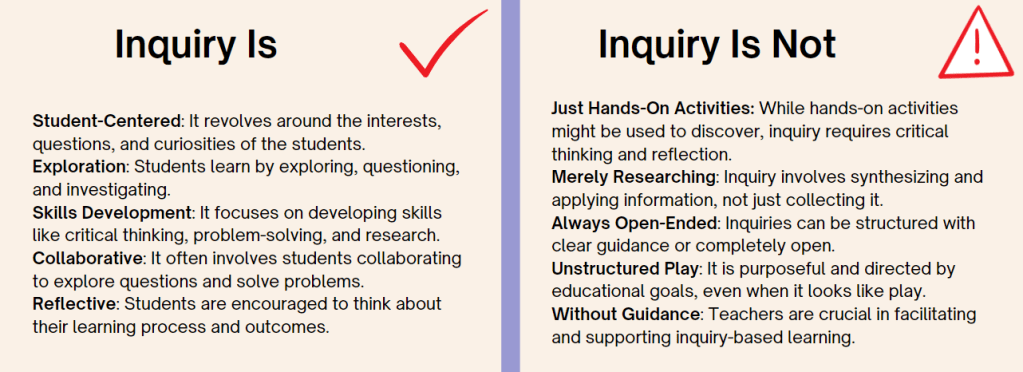
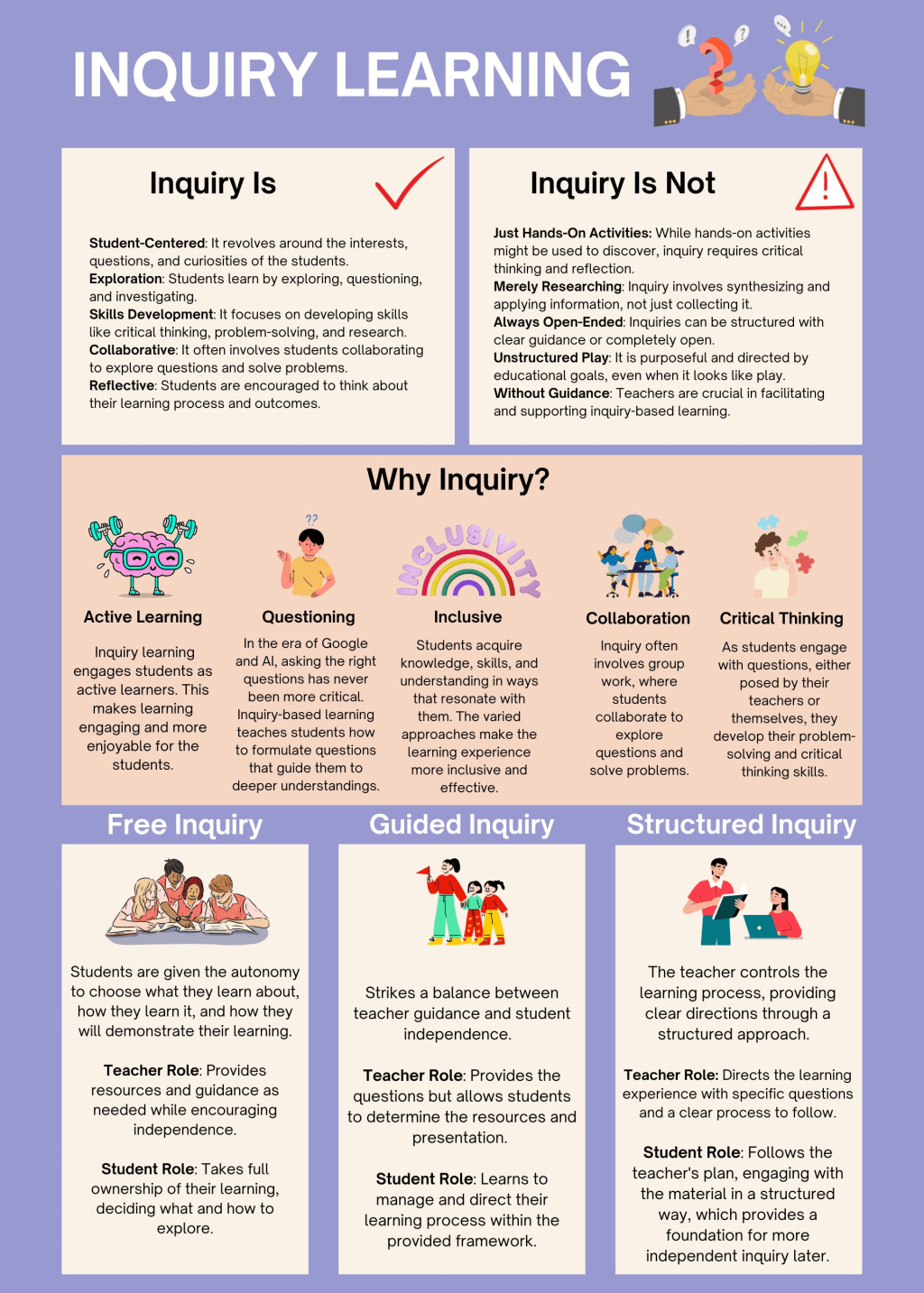
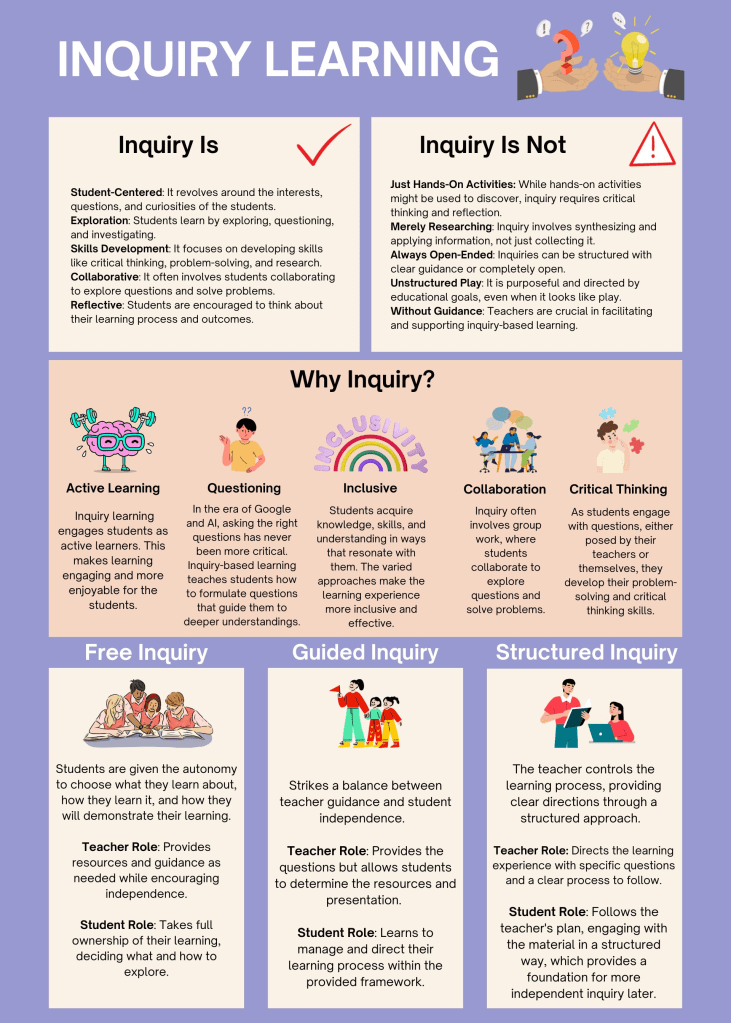
Inquiry Is:
- Student-Centered: It revolves around the interests, questions, and curiosities of the students.
- Exploration Process: Students learn by exploring, questioning, and investigating.
- Skills Development: It focuses on developing skills like critical thinking, problem-solving, and research.
- Active Learning: Students are active participants in their own learning journey.
- Collaborative: It often involves students collaborating to explore questions and solve problems.
- Reflective: Students are encouraged to think about their learning process and outcomes.
Inquiry Is Not:
- Just Hands-On Activities: While hands-on activities might be used to discover or share learning, inquiry requires critical thinking and reflection, not just doing.
- Merely Researching: Research may be a component, but inquiry involves synthesizing and applying information, not just collecting it.
- Always Open-Ended: Inquiries can be structured with clear guidance or completely open, depending on the learning objectives.
- Unstructured Play: It is purposeful and directed by educational goals, even when it looks like play.
- Without Guidance: Teachers play a crucial role in facilitating and supporting inquiry-based learning.

Why Inquiry?
Inquiry is not just another educational buzzword. It is an approach that transforms education to meet the demands of the 21st century. Inquiry-based learning stands out as an approach that equips students with the skills they need for our ever-changing world.
Active Learning: Inquiry learning engages students as active learners; they’re not just passively absorbing information. This makes learning engaging and more enjoyable for the students.
Questioning: In the era of Google and AI, asking the right questions has never been more critical. Inquiry-based learning teaches students how to formulate questions that guide them to deeper understandings.
Inclusive: Students acquire knowledge, skills, and understanding in ways that resonate with them. Whether it’s through hands-on experiments, group discussions, or independent research, the varied approaches make the learning experience more inclusive and effective.
Peer Collaboration: Inquiry often involves group work, where students collaborate to explore questions and solve problems. This teamwork doesn’t just make the task more engaging; it also allows students to learn from one another, offering multiple perspectives and approaches to the question at hand.
Critical Thinking Skills: As students engage with questions, either posed by their teachers or themselves, they develop their problem-solving and critical thinking skills.
Types of Inquiry
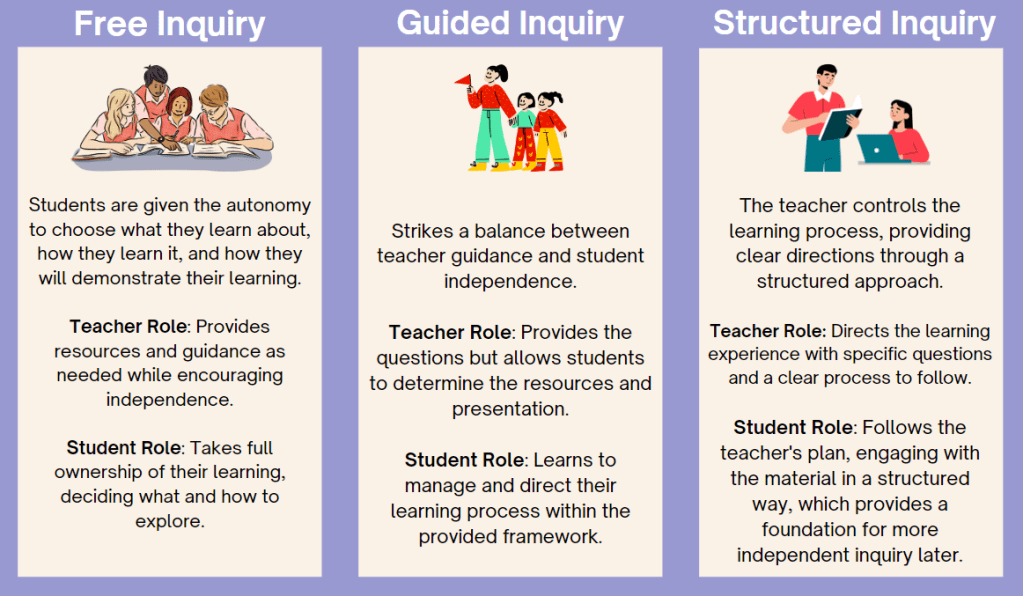
Inquiry-based learning can take several forms, each offering a different level of autonomy to students and requiring various degrees of teacher guidance.
Let’s look at free, guided, and structured inquiry:
Free Inquiry:
In free inquiry, students are given the autonomy to choose what they learn about, how they learn it, and sometimes how they will demonstrate their learning.
Teacher Role: Provides resources and guidance as needed while encouraging independence.
Student Role: Takes full ownership of their learning, deciding what and how to explore.
Examples:
Students might be given time each week to explore topics of personal interest, such as insects or space. The teacher’s role is to facilitate access to resources and provide scaffolds to help students pose questions they can investigate using classroom materials or schoolyard exploration.
Students could undertake a long-term project, like starting a classroom garden. They would decide what to plant, how to care for the garden, and their goals. The teacher supports by helping them to find information and think critically about their choices.
Guided Inquiry:
Guided inquiry strikes a balance between teacher guidance and student independence. The teacher provides the initial question and an outline of the process, but students have the autonomy to navigate their learning within those parameters.
Teacher Role: Provides the questions but allows students to determine the resources and presentation. The teacher offers support and guidance as the students navigate the process.
Student Role: Learns to manage and direct their learning process within the provided framework, developing critical thinking and problem-solving skills by deciding how to approach the problem.
Examples:
The teacher might start a unit on community helpers by asking, “Who helps us in our community, and how?” Students could choose a community helper to investigate, decide how to gather information (interviews, online research, etc.), and present their findings in a format of their choice (poster, presentation, written report).
In an inquiry about renewable energy, the teacher asks, “How can we use renewable energy in our school?” Students could work in groups to explore different forms of renewable energy, select the most feasible option for their school, and develop a proposal outlining the benefits and challenges of implementing their plan.
Structured Inquiry:
Structured inquiry is where the teacher maintains control over the learning process, providing clear directions through a structured approach. Students are given the question and the method to explore, offering a supportive framework for building foundational inquiry skills.
Teacher Role: Directs the learning experience with specific questions and a clear process to follow.
Student Role: Follows the teacher’s plan, engaging with the material in a structured way, which provides a foundation for more independent inquiry later.
Examples:
Students might be learning about the life cycle of butterflies. The teacher would provide a clear sequence of lessons, including observing caterpillars in the classroom, with specific questions to answer at each stage.
In a science class about electricity, the teacher might demonstrate a circuit and then guide students through creating their own, asking them to predict and test what happens when elements are changed.
Resources:
The following Padlet includes some helpful resources that can help you facilitate inquiry-based learning.

Inquiry-based learning is a student-centred approach that nurtures curiosity, encourages critical thinking, and prepares students for the complexities of the 21st century. By varying the level of inquiry from free to structured, educators can tailor their teaching to the developmental stage and readiness of their students, ensuring that each child is both challenged and supported in their learning.
Looking to go deeper with this in your school? I offer coaching and workshops for teams and curriculum leaders. [Learn more here.]



Leave a Reply