
“Getting students to think, and to notice their own thinking, is vital if students are going to gain a sense of where they’re going.”
Frey, Hattie, and Fischer
Developing Assessment-Capable Visible Learners
We often talk about differentiation and scaffolding as ways to tailor instruction to individual needs. But what if the goal was for both educators and students to become assessment-capable?
It’s not just about teachers knowing where a student starts from; it’s also about helping students make that realization. In this blog post, we’ll explore how assessing prior knowledge can go beyond informing instructional decisions to empowering students to take charge of their own learning journey.
The Traditional Role of Assessing Prior Knowledge
You probably start your unit with some form of assessment to gauge what your students already know. This is a cornerstone in teaching; it helps you plan lessons that are appropriate for your students’ level. That’s what we call differentiated instruction. You match the learning experiences to the students’ readiness level, ensuring everyone can access the curriculum.
Examples:
- Pre-tests or quizzes to find out what students already know about the topic.
- KWL charts where students list what they ‘Know,’ ‘Want to know,’ and eventually, what they ‘Learned.’
- Quick polls or show of hands to understand the familiarity of the class with the topic at hand.
The Shift from Teacher-Led to Student-Centered Assessment
While the first approach is foundational, there’s a whole other level we can reach. What if we turned students into active players in this assessment game? When they actively engage in assessing their own prior knowledge, two important things happen.
First, they develop what we call “metacognition,” or thinking about thinking. This skill is not just academic; it’s a life skill. It helps students become assessment-capable by making them aware of their learning processes, thereby turning them into more independent and confident learners.
Second, it opens the door for them to make connections to their own experiences and previous learning. This isn’t just about what’s in the textbook; this is about applying their own real-world understanding to new concepts, and transfer learning. When a student says, “Oh, this is like when I learned about X in another subject or at the museum,” that’s a win.
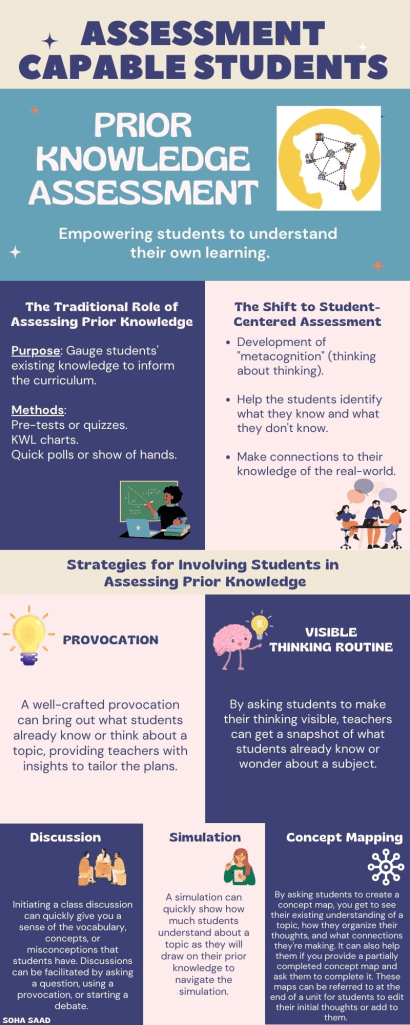
Strategies for Involving Students in Assessing Prior Knowledge
Provocations:
What it is: Provocations are designed to stimulate thought, ignite curiosity, and start conversations. They can be questions, statements, or scenarios that challenge existing perspectives.
How it’s used for prior knowledge assessment: A well-crafted provocation can bring out what students already know or think about a topic, providing teachers with insights to tailor the plans.
Examples:
Early Years: https://www.mlfmonde.org/wp-content/uploads/2020/12/ProvocationsStart-UpGuide-1.pdf
Lower Elementary: Show students a plant and an artificial flower. Ask, “Which one needs water?”
Upper Elementary: Share a picture of a pyramid and ask, “Why do you think people built these?”
Middle School: Start with a statement like, “The most important part of a story is the villain.”
Visible Thinking Routines:
What it is: A set of practices to help students articulate and visualize their thinking processes and become more metacognitive. https://pz.harvard.edu/thinking-routines
How it’s used for prior knowledge assessment: By asking students to make their thinking visible, teachers can get a snapshot of what students already know or wonder about a subject.
Examples:
- Early Years: Use “See-Think-Wonder” with a story cover.
- Lower Elementary: “Chalk Talk” about what they know about landforms.
- Upper Elementary: “Think-Pair-Share” to discuss prior knowledge about fractions.
- Middle School: “Claim-Support-Question” about the water cycle.
Simulation:
What it is: A practical, often hands-on, activity that mimics real-world scenarios.
How it’s used for prior knowledge assessment: A simulation can quickly show how much students understand about a topic as they will draw on their prior knowledge to navigate the simulation.
Example: To assess students’ knowledge about ecosystems, hand each child a card of different biotic and abiotic components like polar bears, ocean, lake, cactus, snakes, etc. Ask Students to form groups without any set criteria, however, they must give logical reasoning for their grouping. Encourage the students to reflect by discussing the most crucial factor in their ecosystem and why it’s important.
Discussion:
What it is: An open conversation about a topic, often facilitated by the teacher. Discussions can be facilitated by asking a question, using a provocation, or starting a debate.
How it’s used for prior knowledge assessment: Initiating a class discussion can quickly give you a sense of the vocabulary, concepts, or misconceptions that students have.
Concept Mapping:
What it is: Concept mapping is a visual tool that allows students to organize and represent their understanding of a particular topic or concept. It helps to uncover the relationships between ideas and can reveal gaps in knowledge.
How it’s used for prior knowledge assessment: By asking students to create a concept map, you get to see their existing understanding of a topic, how they organize their thoughts, and what connections they’re making. It can also help them if you provide a partially completed concept map and ask them to complete it. These maps can be referred to at the end of a unit for students to edit their initial thoughts or add to them.
As educators, our role is not just to convey knowledge but to cultivate thinkers who can navigate and connect the dots in their own learning. The strategies laid out here aren’t just tools for you to assess your students’ prior knowledge. They also empower your students to assess themselves, to think critically, and to own their learning. Make the shift from merely teaching to creating a classroom of assessment-capable learners.
Looking to go deeper with this in your school? I offer coaching and workshops for teams and curriculum leaders. [Learn more here.]


 The Organized Chaos In The PYP Classroom
Leave a reply to Student Agency – The Organized Chaos In The PYP Classroom Cancel reply