
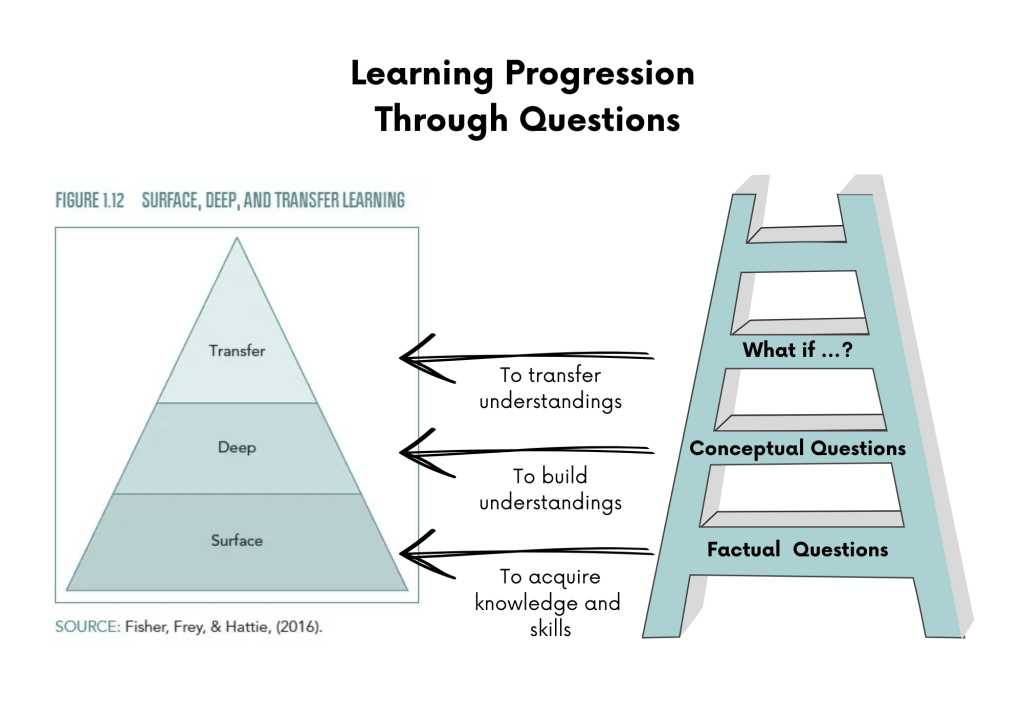
In the PYP, concepts can be viewed as the bridge between facts and conceptual understandings. One strategy that helps students cross this bridge is generalization.
Generalization, as defined in the Principles into Practice, is Connecting and moving from facts, to concepts, to generalizations. Concepts interact with each other to create wider generalizations.
Principles into Practice – Conceptual Understanding. IBO 2023
What does it look like in the classroom?
Before students can reach these conceptual understandings or generalize, it is important that they explore multiple scenarios or case studies. Looking at just one fact or situation is not enough to see a pattern. By comparing and contrasting different examples, students begin to notice connections and similarities that allow them to develop generalizations.
- In science, after investigating how different materials change state, students might generalize: “Matter changes depending on temperature.”
- In language, after comparing stories, they might conclude: “Authors use conflict to develop characters and move the plot forward.”
Why does this matter?
Generalizing helps students articulate their understanding and consolidate their learning. By noticing recurring patterns across multiple examples, they reduce the cognitive load of memorizing isolated facts. In the 21st century, students don’t need to memorize everything; they need to be able to transfer their understanding to different contexts. Supporting them in generalizing their knowledge prepares them for exactly that—connecting, comparing, and applying their learning beyond the original scenario.
💡 Classroom move: As students work with examples, pause and ask: “What do these all have in common? What bigger idea do they show us?” Collect their responses and co-create a statement of understanding together.
Strategies:
One of my favorite strategies for generalizing is working with students to create connections between different concepts or big ideas. Of course, they first need to develop a deeper, age-appropriate understanding of each concept. Once ready, we can use approaches like the 4Cs thinking routine, creating a concept map, or prompting them to answer a conceptual question with a generalization rather than examples; an idea that holds true across many situations.\n\nAs Lynn Erickson reminds us, conceptual curriculum and instruction is about developing deep, transferable understandings rather than memorizing isolated facts. This emphasis is echoed in the PYP, where concepts guide learning and help students connect knowledge across contexts.
References:
- Erickson, H. Lynn (2007). Concept-Based Curriculum and Instruction for the Thinking Classroom. Corwin Press.
- International Baccalaureate Organization (2018, 2024). PYP: From Principles into Practice and updated publications.
- Ritchhart, R., Church, M., & Morrison, K. (2011). Making Thinking Visible: How to Promote Engagement, Understanding, and Independence for All Learners. Jossey-Bass.

 The Organized Chaos In The PYP Classroom
Leave a Reply