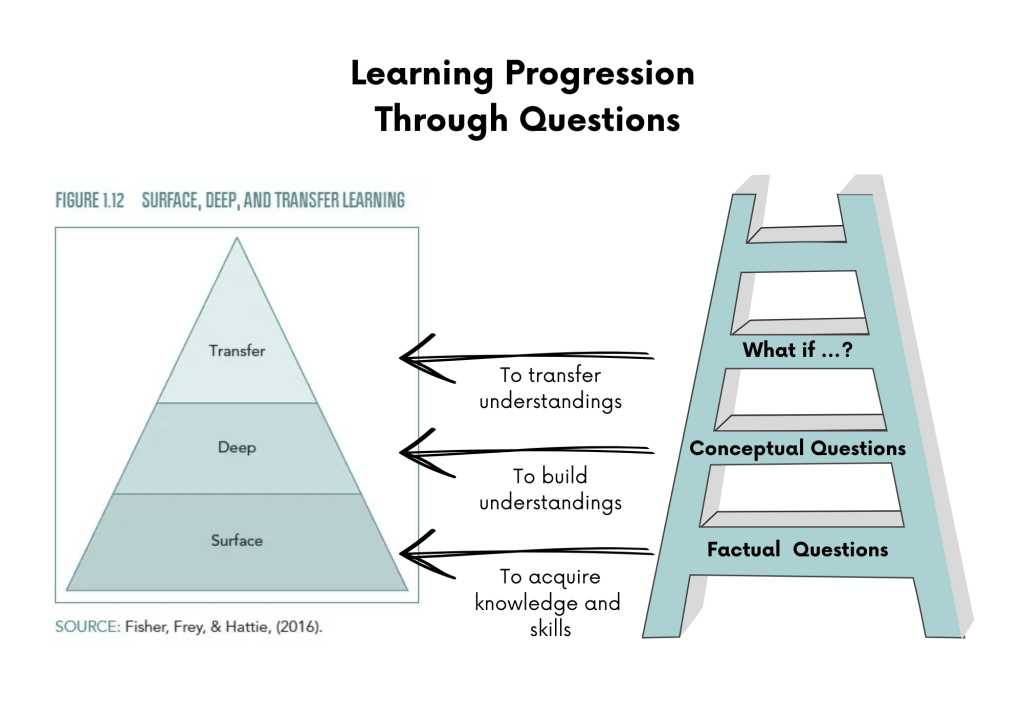
Surface learning gets a bad reputation as ‘rote learning.’ But Hattie emphasizes that it is not superficial at all. Surface learning provides the stepping stones students need to use higher-order thinking, leading them toward deeper understanding as they look for patterns and make connections. John Hattie’s research reminds us that learning, as Hattie defines it, is a progression that should take students beyond surface knowledge into deep understanding and ultimately transfer. Students move through three phases:
- Surface learning, where they acquire key facts and skills,
- Deep learning, where they connect concepts and develop understandings,
- Transfer learning, where they apply their understanding in new and unfamiliar contexts.
As teachers, our role is to design experiences that help students progress along this way. Using questions for planning, teaching, and learning helps us plan intentionally, ensuring the learning engagements scaffold student thinking. Well-chosen questions guide students to notice what matters, to revisit their ideas, and to build the confidence to test their understandings in new situations.
- At the surface level, we ask questions that prompt students to acquire foundational knowledge and skills.
- At the deep level, questions encourage students to understand concepts, make connections and develop conceptual understandings.
- At the transfer level, questions stretch students to apply their knowledge in a different context.
When we strategically plan our questions, we scaffold students’ thinking and help them move from “knowing” and “doing” to “understanding” and “transferring.” A question can become the hinge that shifts students from one phase of learning to the next.
For example, in a unit on ecosystems:
- Surface: What plants and animals live in this ecosystem?
- Deep: How do plants and animals depend on each other?
- Transfer: What might happen if one species disappeared from the ecosystem?
As educators, our challenge is to keep asking: What kind of question will help my students take the next step in their learning?


 The Organized Chaos In The PYP Classroom
Leave a Reply