
In any PYP school, the Programme of Inquiry summarizes the students’ inquiries into real life topics, issues or contexts. It organizes and frames what students learn and how they come to understand and make sense of the world. We want our POI to offer relevant, coherent, and concept-driven learning that can unfold across disciplines and over time.
The IB’s most recent publication Designing a Transdisciplinary Programme of Inquiry is particularly useful in practice, especially when trying to move toward a coherent transdisciplinary curriculum.
Transdisciplinary Learning
The IB defines transdisciplinary learning as …

The document reminds us that transdisciplinary learning invites educators to structure learning experiences around ideas of personal, local, and global significance, drawing on subject knowledge and skills when they support the investigation of those ideas.
It is important to emphasize how subjects are design tools used to ensure coherence when aligned with the POI, concepts, learner needs, and agency.
Subjects are positioned as tools to support deeper inquiry. A unit in the theme How We Organize Ourselves, for example, may be led by social studies and math, but supported/enriched by language, visual arts, and media literacy, when and where those disciplines can authentically extend student thinking. Another example in the image:
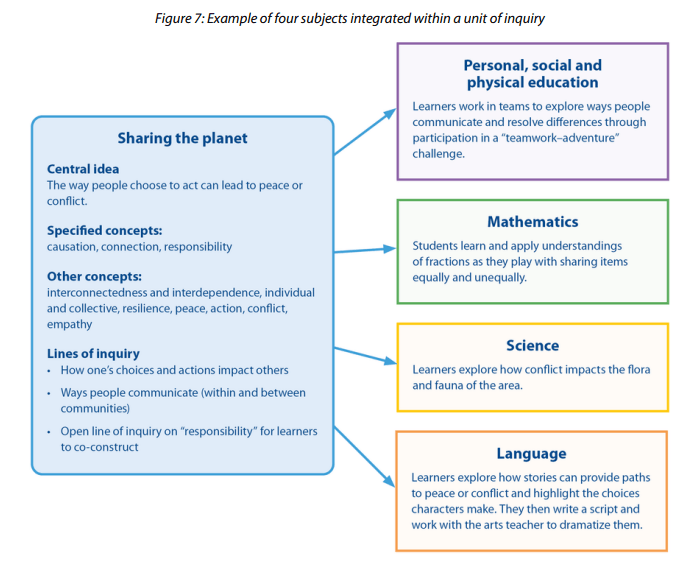
Rather than pushing for every subject to be included in every unit, the document encourages schools to think strategically: identify the subject areas that authentically support the unit, and allow the others to stand alone or support through parallel inquiries where appropriate.
This advice is particularly useful when planning with specialists. Instead of asking every teacher to force a connection to the unit, the conversation becomes:
How can your subject meaningfully support, enrich or extend the ideas students are exploring in the UOI?
The Role of The Transdisciplinary Themes
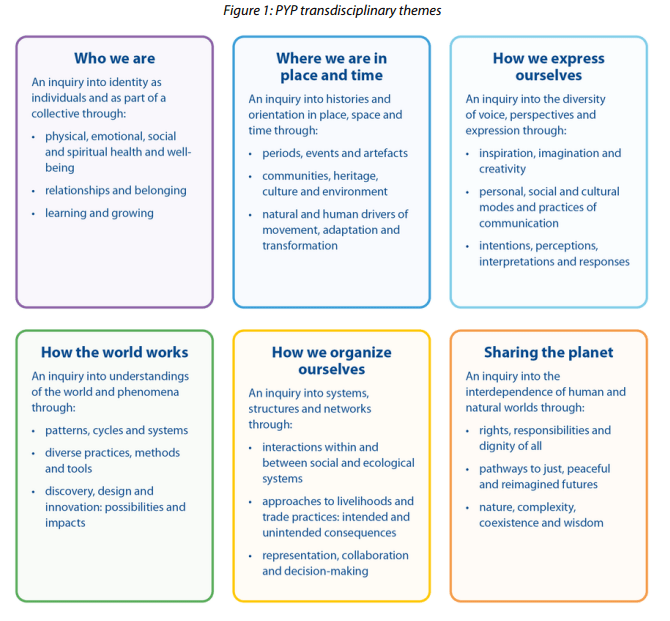
Each theme descriptor includes an opening sentence that clarifies its meaning, followed by three supporting statements that broaden the scope and suggest different entry points. The goal is to use them as planning tools, prompting teams to revisit how the theme is interpreted from one grade level to the next, how different subject areas might bring it to life in different ways, and how the concepts grow in complexity.
In practical terms, this might mean asking: How does Who We Are take on new depth in Grade 4 compared to Grade 1? Are we repeatedly focusing on personal identity, or are we gradually widening the lens to include systems, roles, and social responsibility?
Designing a POI from the Ground Up
For schools building a POI for the first time, or undertaking a significant redesign, the guide proposes three planning questions:
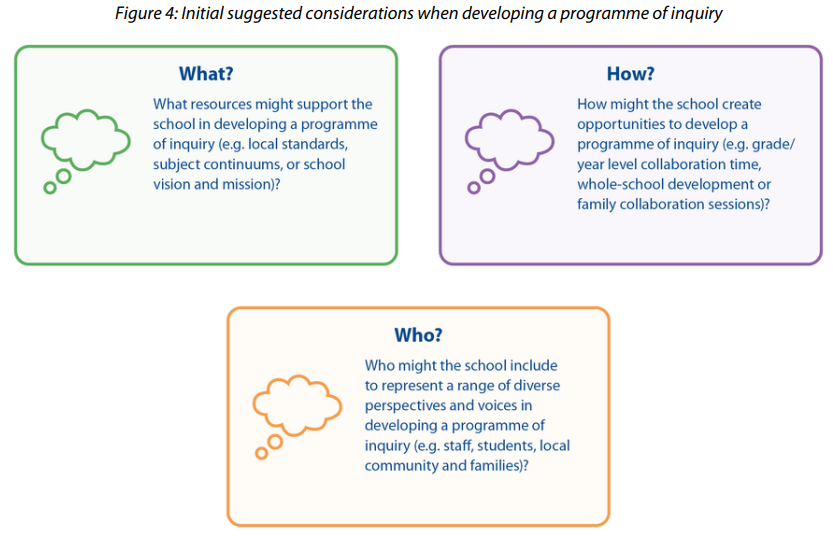
- What resources, time, and structures are available to support curriculum planning?
- How will collaboration happen across teams and subjects?
- Who will be involved in the design, and how will different perspectives be included?
These questions may sound simple, however, they help teams make intentional choices before getting into unit writing. The guide also gives details about what to include in the POI and considerations for each item with question prompts.
Reviewing and Refining the POI
For schools looking to review or refine their POI, the publication outlines a series of reflection questions that are designed to keep the POI responsive and relevant.
- What is emerging in students’ inquiries that we haven’t yet planned for?
- How balanced are our subject area integrations across the year?
Of particular interest is a table that outlines common planning practices and suggests more intentional alternatives. For example, moving away from central ideas that simply name content toward central ideas that support students in constructing conceptual understanding. Or moving away from isolated subject integration to meaningful, planned collaboration that supports the unit’s understandings.
Implications for Implementation
Reading this document again has reminded me that no matter how intentional our planning frameworks are, the real challenge is in implementation. A coherent POI requires dedicated time for collaboration, shared understanding across subject areas, and a willingness to revisit decisions based on student learning.
In my own context, we’re planning to:
- Allocate protected planning time that includes both homeroom and specialist teachers
- Schedule enough time for teachers to investigate the ideas shared in this document
- Keep our POI a living document, reviewed regularly with student evidence in mind
- Use the reflection questions in the guide as part of our annual curriculum review process
- Focus on subject integration that is conceptually rich rather than superficially aligned
- Create space for student voice to influence the development and evolution of units
Looking to go deeper with this in your school? I offer coaching and workshops for teams and curriculum leaders. [Learn more here.]


 The Organized Chaos In The PYP Classroom
Leave a Reply