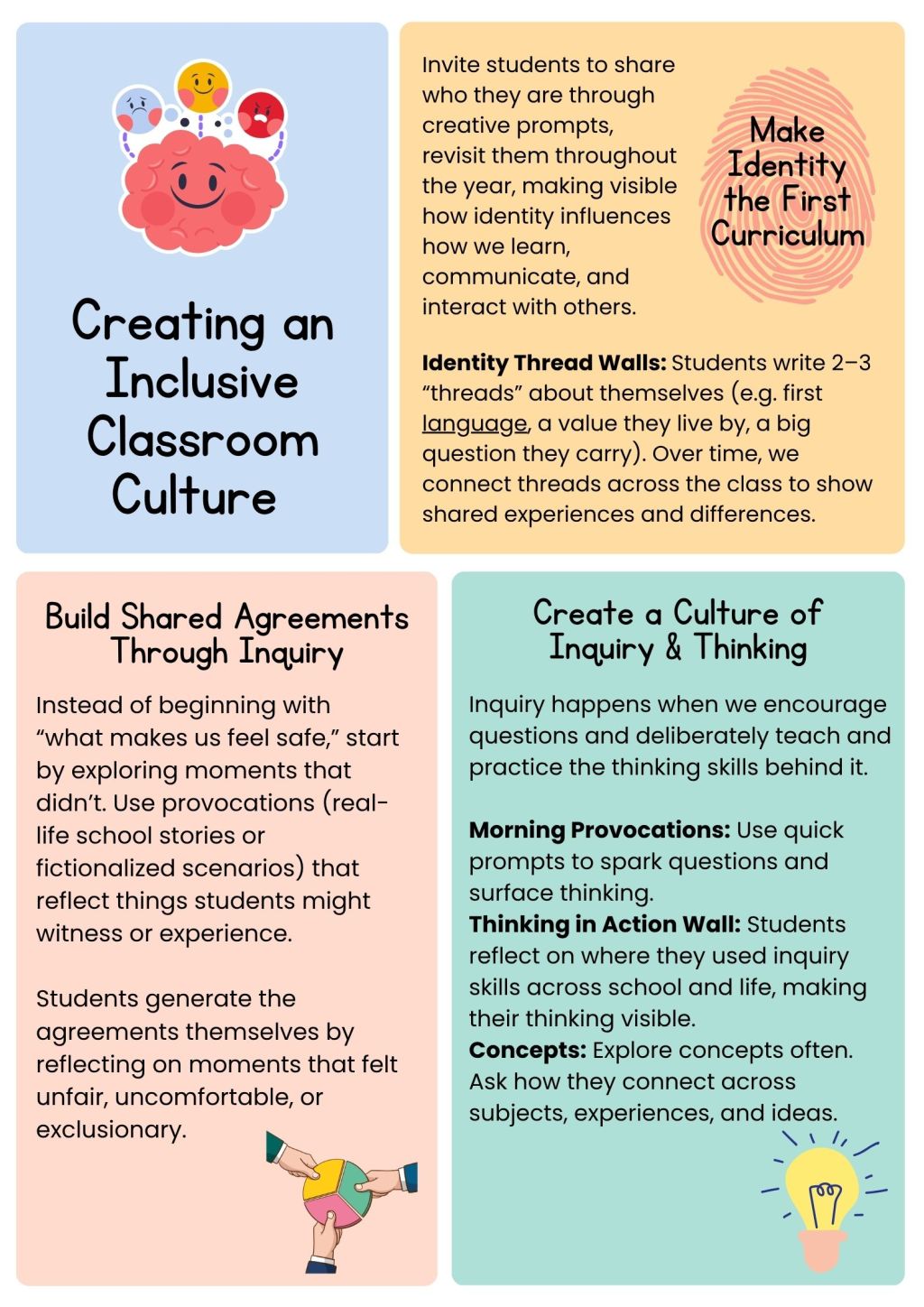
The first weeks of school set the tone for everything that follows. Creating an inclusive classroom culture takes more than icebreakers and classroom agreements. The first weeks of school are a great opportunity to lay the foundation for a learning environment where all students belong, feel seen, valued, and safe to contribute and take risks.
That’s why I treat these early weeks as a time to co-create culture, not just establish order. Rather than relying on icebreakers or generic team-building activities, I focus on helping students feel seen, valued, and safe enough to fully engage socially, emotionally and cognitively. When learners feel that sense of belonging and ownership from the start, they’re far more likely to engage deeply, think critically, and take intellectual risks throughout the year. I want students to bring their whole selves to school, their languages, identities, curiosities, and even their hesitations.

Here are three practical ways to make that happen from the very beginning of the year:
Make Identity the First Curriculum
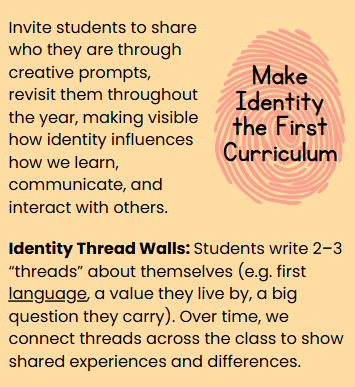
One of the most effective ways to build community is to invite students to share their identities on their terms. Early in the year, I dedicate time for students to explore who they are through storytelling.
There are many creative ways to do this. Some favorites include:
- The Soundtrack of Me: Students create a playlist or share songs that represent their background, values, or personality, with a brief explanation of why each matters.
- Identity Threads Wall: Students write 2–3 “threads” about themselves (e.g. first language, a value they live by, a big question they carry). Over time, we connect threads across the class to show shared experiences and differences.
- What’s in My Backpack? Students design a backpack (real or illustrated) filled with symbolic items that represent who they are, what helps them learn, and what they carry with them emotionally or culturally.
- Identity maps: Students respond to prompts like Where I’m from, What matters to me, and What I wonder about. These become anchors we return to throughout the year.
We revisit them as anchor points in our inquiry, making visible how identity influences how we learn, communicate, and interact with others. This opens up space for multilingualism to thrive and recognizes each learner as a thinker with valuable perspectives.
Build Shared Agreements Through Inquiry
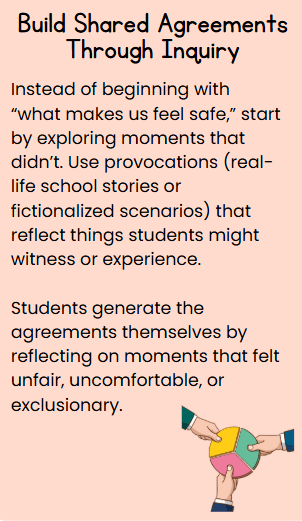
Instead of beginning with “what makes us feel safe,” I often start by exploring moments that didn’t.
I use provocations (real-life school stories, anonymized diary entries, or fictionalized scenarios) that reflect things students might witness or experience:
- A student being left out of a group project because “they’re too slow”
- A classmate mocking another’s accent during reading aloud
- Someone dominating group work and ignoring other ideas
We unpack these moments using visible thinking routines or concept circles:
What values are missing here? What could have helped?
Then we ask …
What does this tell us about the kind of class we want to be?
Students generate the agreements themselves, grounded in real emotion and lived context. The concepts they land on—belonging, fairness, responsibility, respect—aren’t introduced by the teacher. They emerge naturally from the process.
Students generate the agreements themselves by reflecting on moments that felt unfair, uncomfortable, or exclusionary. As we unpack those experiences together, themes like belonging, fairness, responsibility, and respect begin to emerge because students recognized them as necessary. These values grow from shared experiences, honest conversations, and the desire to do better together.
We often finish with a collaborative wall titled:
“What We Want to Be Known For”
Students write statements they hope future students say about their class (e.g. “People listened, even if you weren’t loud”, “It was okay to get things wrong”). These become criteria we revisit, refine, and live by.
This process builds agency from the very beginning. Students see that their voices matter, not just in tasks, but in shaping the emotional and social classroom environment. It also models how conceptual learning works: we move from specific experiences to broader, transferable ideas.
Create a Culture of Inquiry & Thinking

Inquiry happens when we encourage questions and deliberately teach and practice the thinking skills behind it. Early in the year, I highlight the inquiry skills we’ll build across all learning experiences, not just within units, but in how we communicate, collaborate, and reflect as a class.
Some of the core skills we explore include:
- Asking thoughtful and purposeful questions
- Listening actively and empathetically
- Identifying prior knowledge and gaps
- Making conceptual connections
- Interpreting information critically
We teach these skills by embedding them into the different aspects of the school life:
Morning provocations
Short, curious and provocative prompts (objects, dilemmas, etc.) are used to practice generating questions, share perspectives, and notice their thinking patterns.
“Thinking in Action” wall
Students reflect on the skills they used during the week in any context, PE, a disagreement with a classmate, Art critique, or a family discussion. This builds awareness and normalizes inquiry as a way of being.
Concepts
Conceptual thinking becomes part of our everyday conversations. From the beginning, we understand what concepts or big ideas are, we look at provocations and think about relevant concepts, why and how they might connect.
We ask:
- What do these concepts look like in different subjects?
- How do they connect to our experiences, relationships, and learning?
- How do they help us understand the problems we care about?
It takes planning, intention, and the willingness to let students shape the space they learn in to create inclusive spaces where students feel they belong, and safe to make mistakes and take risks. Build habits together with your students over time. Starting the year with identity, values, and thinking gives students tools they’ll use across every interaction. When these practices are revisited regularly, they become part of how the classroom feels.
Looking to go deeper with this in your school? I offer coaching and workshops for teams and curriculum leaders. [Learn more here.]



 The Organized Chaos In The PYP Classroom
Leave a Reply