Being in the 21st century, the workplace has changed dramatically from what it was in the past. We face new challenges every day and continue creating technologies that demand adaptability in our thinking and skill development. Our students need to develop the ability to transfer their knowledge, skills and understandings into new and unfamiliar contexts to keep pace, and solve problems innovatively.
Many respected educators—like Lynn Erickson, Lois Lanning, Julie Stern, Rachel French, Grant Wiggins, and Jay McTighe—have written about and advocated for conceptual learning. About 10 years ago, I began exploring and applying these concepts in my teaching. Then, last year, I decided to take it further by working towards becoming a certified Concept-Based Curriculum instructor. Spending more time exploring conceptual learning has helped me see its implications in planning, teaching, and learning. This allowed me to better implement these strategies, reflect on their impact on student learning, make changes when something doesn’t work, and support my fellow teachers as a PYP coordinator.
Synergistic Thinking

In their book Concept-Based Curriculum and Instruction for the Thinking Classroom, Lynn Erickson, Lois A. Lanning, and Rachel French discuss “synergistic thinking,” which happens when we use what we know—or can do—to develop understandings that transfer across various contexts. It describes the synergy between the facts and concepts.
When students think conceptually, they’re not just memorizing facts. Instead, they develop the capacity to apply existing knowledge and understandings in unfamiliar scenarios. By focusing on broader ideas, they learn to recognize how seemingly separate pieces of information can relate to one another.
Conceptual Learning

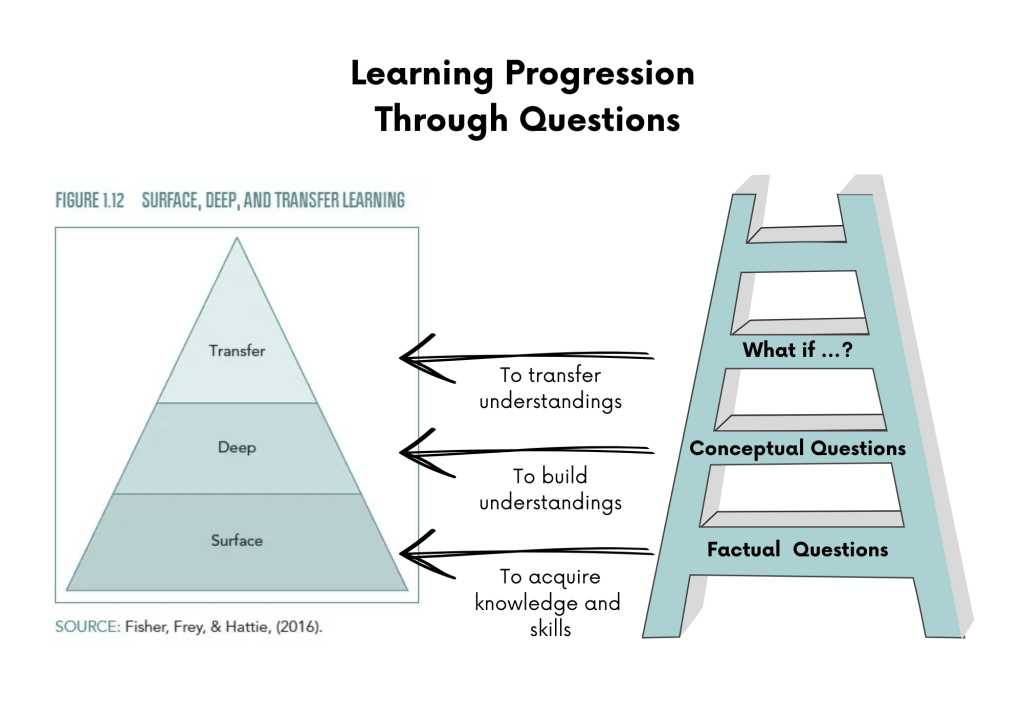
Conceptual teaching and learning means scaffolding students to understand big ideas, find patterns and make connections that apply across different subjects and real-world settings. Instead of focusing on memorizing facts, conceptual learning encourages “connecting the dots” between concepts, allowing for deeper understanding and transfer of knowledge.
To help students with synergistic thinking, Lynn Erickson suggests organizing knowledge under concepts. Once students understand these concepts, they can start making connections between them, leading to deeper conceptual understandings. To transfer their understandings, encourage students to examine how they apply to different contexts.
How to Bring Synergistic Thinking to Your Classroom

Knowledge, Skills and Understandings
Examine the standards or learning outcomes to …
- identify the main concepts, use them to create the conceptual understandings the students should develop,
- what students need to know and do to understand these concepts,
- strategies to help them organize their findings, find patterns, and make connections between the concepts to develop conceptual understandings.
Example:
Do:
Science Standard: Identify structures and functions of living organisms that help them survive, grow, and reproduce.
Know:
- Basic characteristics and needs of living organisms (food, water, shelter, air)
- Examples of structures (roots, stems, leaves, shells, fur) and their functions.
Understand:
Concepts: structures, functions, survival
Conceptual Understanding: Living organisms share common needs, but their structures may vary based on the environment.
Real-Life Scenarios and Case Studies
Use a variety of real-life scenarios and case studies to help students build their knowledge. Encourage them to organize their findings, find patterns and make connections as they compare and contrast different scenarios and case studies.
Example:
Through a variety of primary and secondary resources, students can investigate the following case studies to develop the conceptual understanding ” All living organisms share common needs, but their structures may vary based on environment.”
- Beak Shapes in Birds
- Desert Plant Adaptations
- Camouflage
- Thick Bark in Redwood Trees
- Insulation in Polar Bears
Guiding Questions
Plan your questions strategically to scaffold student thinking. Plan the guiding questions to …
* guide students’ inquiry into the case studies,
* develop an understanding of the concepts, and
* make connections between the concepts to develop conceptual understandings.
Example:
Students can use the following guiding questions to investigate the case studies.
- Which physical features does this organism have that help it obtain food or water?
- What adaptations does the organism use for protection against predators and threats?
- What characteristics of this structure make it especially well-suited for the organism’s habitat?
- How do organisms in different environments meet the basic survival needs?
By focusing on conceptual learning and synergistic thinking, we empower our students to become more adaptable, innovative, and resilient—exactly the qualities needed in our rapidly changing world.
The following Padlet includes some helpful resources that can help you facilitate inquiry and concept based learning. https://padlet.com/sohaoak86/Inquirylearning
Looking to go deeper with this in your school? I offer coaching and workshops for teams and curriculum leaders. [Learn more here.]
References
- Erickson, H. Lynn, Lois A. Lanning, and Rachel French. Concept-Based Curriculum and Instruction for the Thinking Classroom. Corwin, 2017.
- International Baccalaureate Organization (IB). (2018). PYP: From Principles into Practice.


 The Organized Chaos In The PYP Classroom
Leave a Reply