
What is the SOLO Taxonomy?
SOLO stands for the Structure of Observed Learning Outcomes. SOLO taxonomy provides a framework that helps both educators and students understand their levels of thinking and learning, beginning with simple knowledge and skills acquisition and advancing to the ability to transfer understanding to different contexts.
In this post, we will explore ways educators can use SOLO taxonomy to align teaching, learning and assessment to empower students to become assessment-capable.
- Levels of SOLO taxonomy
- Why SOLO taxonomy?
- Phases of learning (Frey, Hattie and Fisher)
- Connecting SOLO levels with the phases of learning
- Theory to Practice: how can educators use SOLO taxonomy to plan, teach and assess (teacher assessment, student self-assessment and feedback)
Use this link to download the templates (Rubric and Self-Assessment):
SOLO Taxonomy Levels
SOLO Taxonomy provides a simple way of describing how learning outcomes grow in complexity from surface to deep to conceptual understanding to learning transfer (Biggs and Collis 1982). It describes five levels of understanding for students who are encountering new learning …


Why SOLO Taxonomy?
Align Teaching, Learning, and Assessment:
The gradual progression from knowledge to understanding to transfer within the SOLO levels allows teachers to align their lesson plans with learning outcomes and assessment effectively, positively impacting student learning.
Depth of Learning:
SOLO taxonomy emphasizes helping students deepen their understanding step-by-step, from acquiring knowledge to making connections and ultimately applying their knowledge in new contexts.
Scaffolding Instruction:
By assessing the depth of student understanding, educators can tailor their instruction to meet diverse learning needs more effectively.
Student Agency:
Understanding the SOLO levels and their representations helps students realistically assess their learning and set appropriate goals.
Align Teaching, Learning and Assessment
Phases of Learning
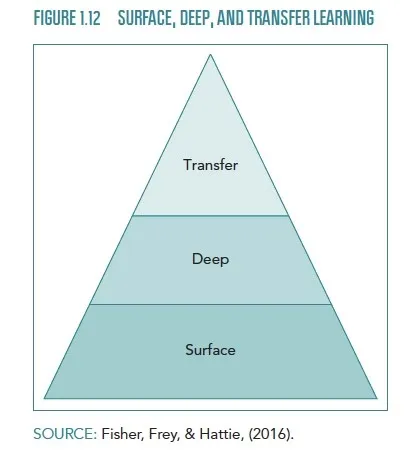
The SOLO taxonomy is a powerful framework because it allows you to align your lesson plans with both assessments and the learning outcomes/standards. It’s important for educators to remember that we design learning experiences that help students develop their knowledge, skills, and understanding. When working with a prescribed curriculum, we need to check how flexible it is and possibly rethink the learning outcomes to make sure our students can smoothly advance through the different SOLO levels and learning phases.
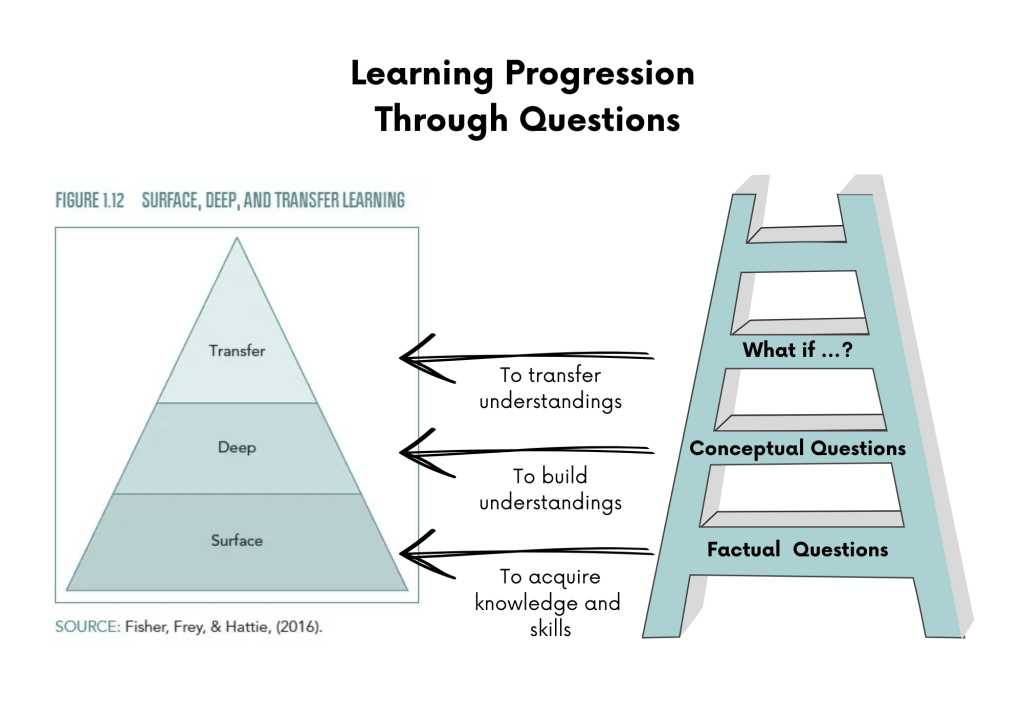
Frey, Fisher, and Hattie describe three phases of learning: surface, deep, and transfer. Let’s explore each phase and see how they align with the SOLO levels to create effective learning outcomes.
Surface Learning:
What?
- Is NOT superficial learning.
- Exposing students to important and relevant skills, knowledge, concepts and strategies.
Why?
Builds a foundation that allows students to think deeper in the next learning phase.
Deep Learning:
What?
- Involves understanding the meaning and significance of information.
- Can only be accomplished when students acquire pre-requisite knowledge, skills and strategies.
- It takes more instructional time.
Why?
- Apply and extend their surface learning to support deeper conceptual understanding.
- Develop critical thinking and problem-solving skills.
Transfer Learning:
What?
- Apply knowledge, skills and understanding in a new context, could be a familiar context (near transfer) or less familiar, across subjects (far transfer)
- See the connections between their learning and real life context.
- Reflect on their learning.
Examples of Progression From Surface to Transfer Learning
Language Arts: Story Elements
Surface: Students learn about story elements like setting, characters, and plot through straightforward definitions.
Deep: Students analyze a given story to identify and discuss its various elements and how they interplay.
Transfer: Students are given a setting and a character to create their own story plot incorporating those elements.
Science: Water Cycle
Surface: Students learn about the states of water and how changes to the states occur through experiments and readings.
Deep: Students examine the states of water as they investigate the water cycle.
Transfer: Students assess the impact of climate change on the availability of water.
Connecting SOLO Levels with Learning Phases

When developing learning outcomes, start by supporting students as they identify their prior knowledge. It’s essential to help students understand what they know before they begin new learning.

Unistructural and Multistructural Levels:
At these levels, focus on building surface knowledge. Help students acquire knowledge, skills, and an understanding of main concepts, preparing them for deep conceptual understanding. Design learning experiences that develop their knowledge using these verbs:
Unistructural: List, Identify, Find, Label, Match.
Multistructural: Describe, Classify, Illustrate, Define.

Relational Level:
At this level, students use thinking skills to organize their learning and make connections between concepts, creating deep conceptual understandings. Similar to the deep learning phase, students need to use the knowledge and skills acquired to build deeper connections. The development of critical thinking skills at this phase is critical for students in order for them to be able to make those deeper connections. Design learning experiences that encourage students to:
Relational: Analyze, Compare, Contrast, Make connections.

Extended Abstract Level:
Here, students test their understanding in familiar and unfamiliar contexts, similar to the transfer learning phase. Design learning experiences that encourage students to:
Extended Abstract: Hypothesize, Predict, Reflect, Create, Invent, Solve.
Theory to Practice: How Can Educators Use SOLO Taxonomy to Plan, Teach, and Assess Learning?
Create Learning Outcomes Aligned with SOLO Levels
Design learning outcomes that correspond with the different SOLO levels to guide students clearly from surface to transfer learning.
Develop a Rubric to Set Expectations
Construct a rubric that clearly outlines your expectations for students at each SOLO level for each learning outcome. This will clarify what success looks like at every stage.
Assess Students’ Prior Knowledge
Evaluate your students’ existing knowledge and understanding to determine their starting level within the SOLO framework. Use this assessment to adjust your lesson plans and instructional strategies, ensuring they are appropriately challenging.
Align Your Lessons with SOLO Levels
Ensure that your lesson plans are aligned with SOLO levels, facilitating a smooth transition for students from one level to the next. This alignment helps maintain a coherent and progressive learning experience.
Use HOT SOLO Maps
In their book “SOLO Taxonomy: Guide for Schools,” Pam Hook and Julie Mills share a few maps to use for
- Bringing in ideas – Uni and Multi-structural levels
- Connecting ideas – Relational learning level
- Looking at connecting ideas in new ways – Extended Abstract level
Introduce SOLO Levels to Students
It is important for the students to understand the different SOLO levels and to use them for self-assessment. Using the SOLO level symbols and age-appropriate language can be very helpful. For example:
| Prestructural | I need help to get started |
| Unistructural | I know a little about this topic. |
| Multistructural | I know a lot about this topic |
| Relational | I can make connections to understand the topic. |
| Extended Abstract | I can look at my understanding in different ways. |
It’s important for us, educators, to recognize that students’ understanding of the SOLO levels should continually develop. This understanding evolves not only as they mature but also as they encounter different subjects. Pam Hook’s book, A Children’s Guide to SOLO Taxonomy, illustrates the SOLO levels through a story about a child learning to bake scones, offering an easy introduction to these concepts. However, I’ve found it equally important to demonstrate how the SOLO levels apply across various subjects. Exposing students to the application of SOLO levels in different subject areas helps them see the relevance and adapt these strategies to different contexts.
Co-construct Success Criteria with Students
Engage students in developing success criteria by examining exemplars. This collaborative process helps students understand quality work and sets clear expectations.
Encourage Self-Assessment with a Simplified SOLO Rubric
Provide students with an age-appropriate version of the SOLO rubric to encourage regular self-assessment. This practice empowers them to take ownership of their learning and understand their development through the SOLO levels.
Ensure Ongoing Assessment and Targeted Feedback:
Continuously assess students to monitor their understanding and progress through the SOLO levels. Provide feedback that is specific, actionable, and directly linked to the success criteria and the rubrics you’ve shared. This approach helps students clearly identify their next steps and understand how their work aligns with the expected learning outcomes. Feedback should be timely and expressed in a way that resonates with students, making it easier for them to understand and apply it effectively.
Visit this Padlet to learn more about developing assessment-capable students: https://padlet.com/sohaoak86/assessment-becoming-assessment-capable-bxjqo0lpib5w2f4f
Looking to go deeper with this in your school? I offer coaching and workshops for teams and curriculum leaders. [Learn more here.]



 The Organized Chaos In The PYP Classroom
Leave a Reply