
Albert Einstein once said, ‘Education is not the learning of facts, but the training of the mind to think.’
Have you ever wondered what it would look like if students were architects of their own learning? Let’s explore the power of student agency.
A few years ago, the concept of student agency emerged as the foundation for fostering engaging and inclusive learning environments. This blog post delves into student agency, exploring how it connects with self-efficacy to develop autonomous learners and offering classroom examples.
Understanding Student Agency
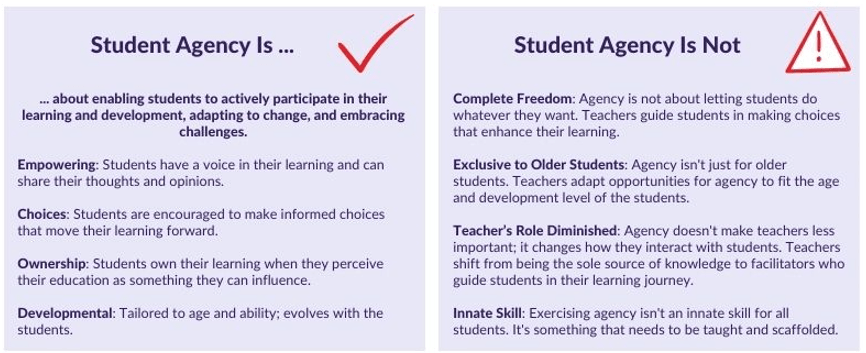
Student Agency requires a fundamental shift in how we perceive learning. It’s about enabling students to actively participate in their learning and development, adapting to change, and embracing challenges.
Agency, as defined by renowned scholars …
Agency enable[s] people to play a part in their self-development, adaptation, and self-renewal with changing times.
Bandura (2001)
Learning with agency is an entirely different cognitive and physical activity, leading to powerful learners who choose to take on challenges with their whole being.
Williams (2017)
Self-Efficacy
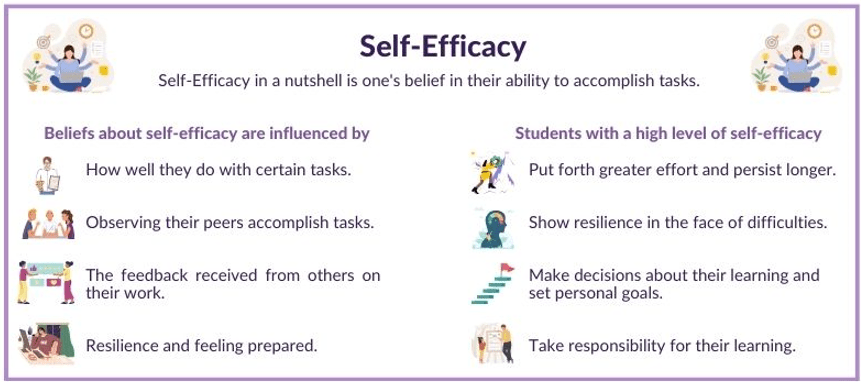
The foundation of agency lies in the concept of self-efficacy. Bandura defines self-efficacy as one’s belief in their ability to accomplish tasks. He argues that one’s beliefs about their self-efficacy vary across subjects and tasks and are influenced by …
- Mastery experiences; how well they do with certain tasks.
- Watching their peers as they accomplish tasks.
- The feedback they receive from others on their work.
- Resilience and feeling prepared.
Studies show that students with a high level of self-efficacy are more likely to …
- put forth greater effort,
- persist longer,
- show resilience in the face of difficulties,
- make decisions about their learning,
- set personal goals,
- and take responsibility for their learning.
Students with high self-efficacy view challenging problems as tasks to be mastered, not avoided. They exhibit a higher degree of ownership over their learning process, a vital component of agency.

Voice, Choice, and Ownership
Voice, choice, and ownership are three aspects that educators must understand in order to empower student agency. If we consider our ultimate goal for the students to develop a positive view of their ability to accomplish tasks and succeed “self-efficacy,” we must encourage students to take ownership of their learning.
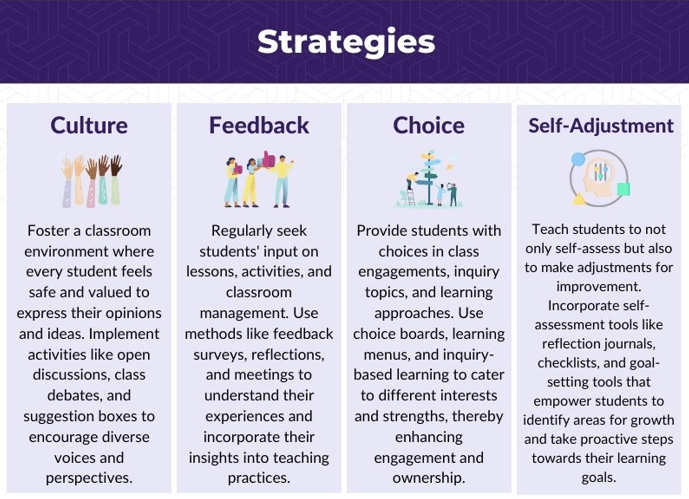
Ownership: Students own their learning when they perceive their education as something they can influence. It leads to a deeper commitment to their learning process. As educators, our role is to encourage them to examine their work, evaluate themselves, recognize when they don’t know something, use tools and strategies to learn independently, and seek others’ help when they are stuck. Our role is to teach them to self-assess and self-adjust, equip them with tools and strategies that they can refer to, and support them as they become independent learners.
Voice: Students feel respected and valued when their thoughts and opinions are heard and considered. We should encourage students to have a voice, share their opinions and thinking, and feel safe about it. When students are given a voice, they feel valued and respected, which reinforces their sense of ownership.
Choice: Choice involves providing students with options in the learning process. This could mean choosing topics of interest, learning methods, or ways to demonstrate their understanding. Choice empowers students by allowing them to take control of their learning, aligning with their interests and strengths, and promoting a more personalized learning experience.

Myths and Misconceptions About Student Agency
Agency Means Complete Freedom: Agency is not about letting students do whatever they want; it’s about allowing students to make choices and share their voice. Teachers guide students in making decisions that enhance their learning.
Only Older Students Can Exhibit Agency: Agency isn’t just for older students. Young children can also make choices about their learning and take active roles. It’s about adapting opportunities for agency to fit the age and development level of the students.
Student Agency Diminishes the Teacher’s Role: Agency doesn’t make teachers less important; it changes how they interact with students. Teachers shift from being the sole source of knowledge to facilitators who guide students in their learning journey. This approach enhances the teacher-student relationship, making it more collaborative.
All Students Naturally Know How to Exercise Agency: Exercising agency isn’t an innate skill for all students. It’s something that needs to be taught and scaffolded. Teachers play an important role in helping students learn how to make choices and take control of their learning.
Student Agency Is a Uniform Practice: There’s no one-size-fits-all approach to student agency. It looks different in every classroom and for every student. Teachers need to tailor their approach to fit the needs and abilities of their students, ensuring that agency is meaningful and effective for each individual.
Classroom Examples
Language Arts:
In a language class, the teacher decided to work with the students on expanding sentences as it is one of the standards. The teacher started by reading different sentences with the students – some were well-written, while others were not. Together, they looked at these sentences and talked about what made the good ones stand out. They came up with a list of features that make a sentence strong.
Next, the teacher worked with the students to co-construct success criteria in form of “I can” statements. These statements were like goals for the students to aim for in their writing.
Over the following weeks, the teacher guided the students as they inquired about different strategies and practiced writing sentences in a variety of ways. They were given choices, such as describing pictures, coming up with their own sentences, using manipulatives and editing sentences. There was a center where the teacher was always situated and students were able to seek support when they got stuck. From time to time, the teacher would walk around the room and offer feedback to the students.
I can statements & strategies:
- I can add details to my sentence.
Strategy: Use the following formula to expand your sentence (Who, does what, where and when). Use adjectives to describe nouns.
- I can begin with a capital letter.
Strategy: Review the capital letter visual aid.
- I can end the sentence with punctuation.
Strategy: I can review my writing and ask a peer to review it for me.
- I can review and edit my spelling.
Strategy: Use your spelling dictionary to check your spelling. Circle the words you are unsure of and ask peers or your teachers for feedback
Every Thursday, the students would examine at their own work and use the “I can” statements to reflect on their progress. They picked two things they did well (their “two stars”) and one thing they wanted to improve (their “wish”). On Fridays, they focused on their goal during the literacy session.
Unit of Inquiry
At the beginning of a unit on ecosystems, the teacher planned two activities to assess the students’ prior knowledge and help them identify what they knew and didn’t know.
The first activity was a debate. The students examined statements about ecosystems and had to decide if they agreed or disagreed. They talked about this in their groups, and constructed arguments to convince the others’ of their opinion.
The second activity was a simulation game. Each student acted as a part of an ecosystem, like a plant, animal, or rock. They grouped themselves into ecosystems that made sense together. The students were asked to provide a rational for their grouping and think about which element they would have liked to take from another group to enhance theirs.
During both activities, the students realized they knew some things about ecosystems, but they also had many questions. The teacher provided them with a sheet that helped them list down their questions and document their arguments and rationale. This helped everyone see what they knew and what they were curious about.
For the rest of the unit, the teacher picked questions that matched the curriculum standards and added them to the daily plan. This showed the students that their questions were important. Questions that didn’t fit into the unit were saved for the end. The teacher provided time for students to research these questions towards the end of the unit.
Classroom Environment:
At the start of the year, the third-grade teachers talked about giving students more agency in setting up their classrooms. One teacher was really keen on this idea. So, she left her classroom walls empty and put all the furniture to the side. She spent the first two days making a plan with her students on how to set up the room.
Another teacher was a bit unsure about this approach. To start, she arranged the furniture herself but left the walls blank. On the first day, she had a guided conversation with the students about the different activities they’d be doing. Then, she allowed them to create different plans. The next day, the teacher sat with the student to choose the best ideas from each plan. As they went through the unit, she worked with the students to decide where to put their work and visuals on the walls.
This way, both teachers worked towards empowering student agency, each at their own comfort level. The students got a chance to contribute to their learning environment, making the classroom feel more like their own space.
If you would like to learn more about student agency, check this Padlet.
Fostering student agency transforms the students’ experience, creating a vibrant learning environment where students are not just learners, but active participants in their education. By promoting student voice, encouraging feedback, offering diverse choices, and enhancing self-assessment skills, educators empower students to take ownership of their learning journey.
Looking to go deeper with this in your school? I offer coaching and workshops for teams and curriculum leaders. [Learn more here.]



 The Organized Chaos In The PYP Classroom
Leave a Reply