
We’ve been diving deep into inquiry-based learning, looking at the role of teachers in promoting inquiry skills in students in each phase. First, we talked about using provocations to kick things off – figuring out what our students know, and getting them hooked on the unit. Then, we moved on to exploring strategies to scaffold students to conduct independent investigations. But there’s more to inquiry-based learning than just finding out. The real magic happens when students piece together all that they’ve learned, making sense of it in a way that sticks. That’s what I like to call “Connecting the Dots.” It’s about taking those findings from their investigations to understand big ideas and concepts, understanding the ‘what,’ ‘why’ and ‘how’ of things.
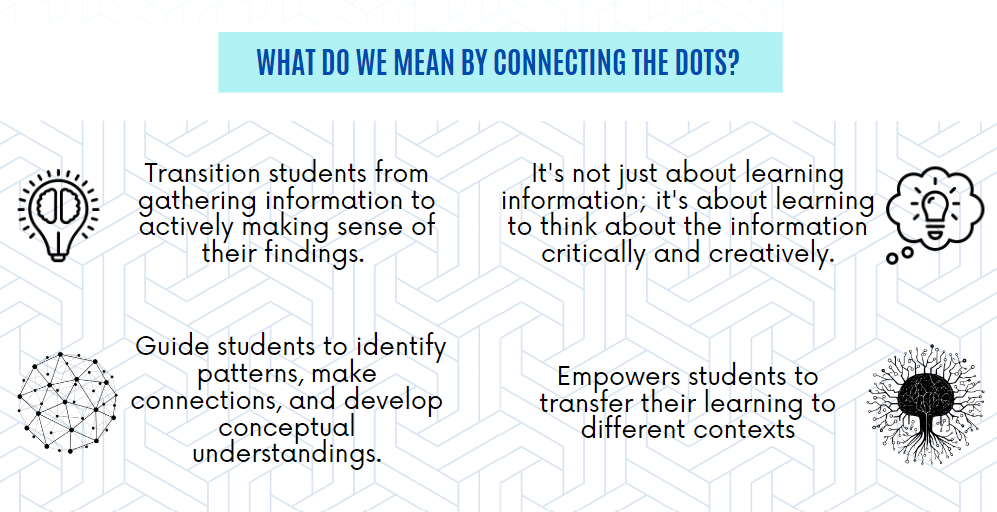
What Do We Mean By Connecting The Dots?
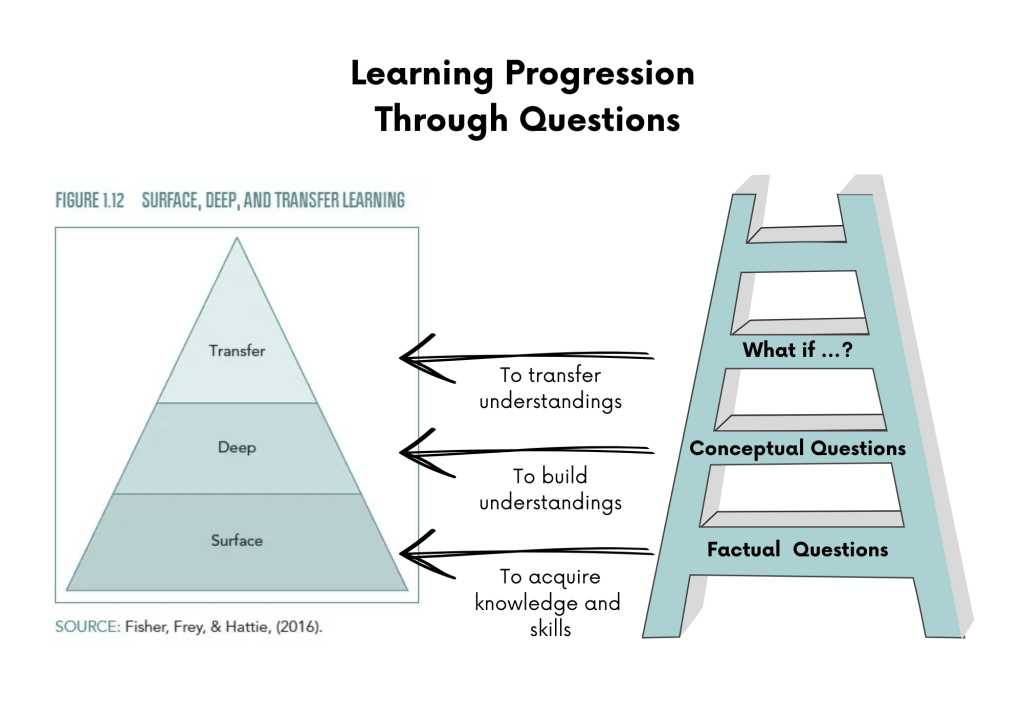
In “Connecting the Dots” phase, students transition from gathering information to actively making sense of their findings. This is where teachers play an important role in guiding students to identify patterns, make connections, and build a deep understanding of the unit’s main concepts. It’s not just about learning information; it’s about learning to think about the information critically and creatively.
During this phase, students engage in higher-order thinking skills. They analyze the data collected, compare different pieces of information, and synthesize these to form conceptual understandings. This process enables students to transfer their learning to different contexts, helping them to see the relevance of their classroom knowledge in the real world.
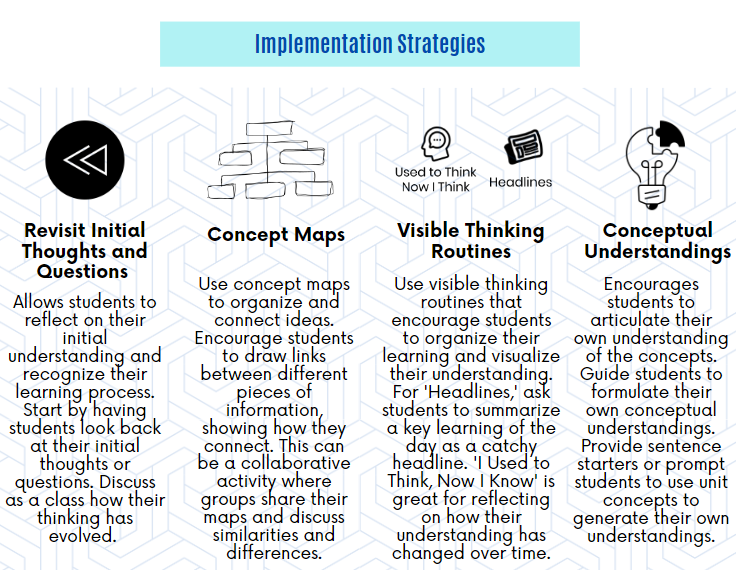
Strategies For Effective Implementation
To support students in making sense of their learning and developing transferable understandings, consider these strategies:
Revisit their initial thoughts and questions
Allows students to reflect on their initial understanding and recognize their learning process. Start by having students look back at their initial thoughts or questions. Discuss as a class how their thinking has evolved. This can be done through a reflective journal entry or a class discussion.
Concept Maps
Helps visualize relationships between different concepts. Use concept maps to organize and connect ideas. Encourage students to draw links between different pieces of information, showing how they connect. This can be a collaborative activity where groups share their maps and discuss similarities and differences.
Visible Thinking Routines
Use visible thinking routines that encourage students to organize their learning and visualize their understanding. For ‘Headlines,’ ask students to summarize a key learning of the day as a catchy headline. ‘I Used to Think, Now I Know’ is great for reflecting on how their understanding has changed over time. ‘Color, Symbol, Image’ lets students choose a color, symbol, or image to represent their understanding of a concept.
Writing
Develops communication skills and helps consolidate learning. Have students write about what they’ve learned in different formats – stories, reports, poems, persuasive letter, etc. Tailor the writing genre to match the unit’s theme.
Data charts
Organize and interpret data effectively. Teach students how to create and read data charts. Use charts to compare information, track changes over time, or sort data.
Venn Diagrams
Visually demonstrates similarities and differences between concepts. Use Venn diagrams in group activities or individually to compare two or more concepts.
Conceptual Understandings
Encourages students to articulate their own understanding of the concepts. Guide students to formulate their own conceptual understandings. This can be done through group discussions, where students debate and refine their ideas, or through individual reflections, where they write or present their understandings. Provide sentence starters or prompt students to use unit concepts to generate their own understanding, promoting independent and critical thinking.
Classroom Examples
Exploring Weather Patterns
In an early years classroom, the teacher used provocations like weather charts, nature walks, and storybooks about seasons to ignite curiosity about weather patterns. Students investigated different types of weather by observing and recording daily weather changes.
After gathering their observations, the students created a large collaborative concept map, illustrating the different weather types they had observed. Using a ‘Color, Symbol, Image’ routine, each child chose colors, symbols, and images to represent different weather conditions. The teacher facilitated a discussion where students shared their symbols and what they represented, helping them to see the general patterns in weather changes.
Understanding Ecosystems
An elementary class started with a provocation involving a local ecosystem field trip, initiating an inquiry into ecosystems. Students investigated different ecosystems, their flora and fauna, and their environmental conditions.
Students revisited their initial questions about ecosystems and used Venn diagrams to compare and contrast two ecosystems they had studied, then they wrote a statement of understanding using the following prompt “After comparing these ecosystems, I understand that…”. They then wrote short reports, synthesizing their findings. The teacher encouraged students to use data charts to represent the types of plants and animals found in each ecosystem, facilitating a deeper understanding of the biodiversity in different environments.
Ancient Civilizations
Middle school students were intrigued by a series of historical artifacts and timelines, which led to an investigation of ancient civilizations. They explored different aspects like culture, politics, and technology.
The students used the ‘I Used to Think, Now I Know’ routine to reflect on their initial understanding versus their current understanding of ancient civilizations. They engaged in a Socratic seminar to discuss the similarities and differences between the civilizations they studied. Finally, they created their own conceptual understandings by writing and presenting how these ancient civilizations have influenced modern society, integrating history, politics, and culture.
Resources:
The following Padlet includes some helpful resources that can help you facilitate inquiry-based learning.
https://padlet.com/sohaoak86/Inquirylearning
Guiding students through this phase of inquiry-based learning empowers them to not only accumulate knowledge but to deeply understand and apply it. By engaging in these strategies, students develop critical thinking skills and gain a comprehensive understanding of complex concepts.
Looking to go deeper with this in your school? I offer coaching and workshops for teams and curriculum leaders. [Learn more here.]



 The Organized Chaos In The PYP Classroom
Leave a Reply