

After my previous post about inquiry-based learning, I’ve decided to explore the process of facilitating the inquiry process in a series of posts, beginning with the role of provocation in creating a culture of curiosity.
As an educator deeply invested in the learning process, I’ve always found the beginning of a new unit of inquiry (UOI) exciting. In my experience, one of the most dynamic ways to launch this journey is through the use of provocations. Provocations are engaging and intriguing learning engagements that pique students’ curiosity about new concepts and topics.
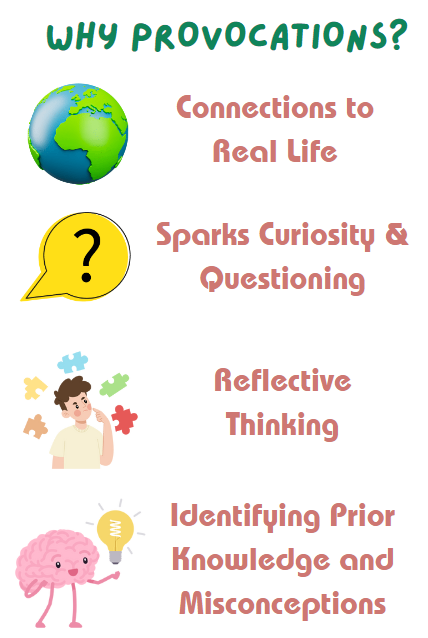
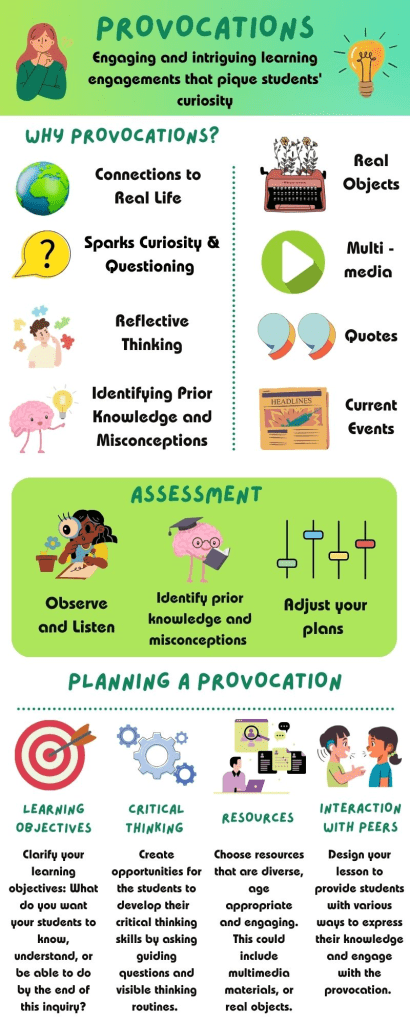
Why Provocations?
Connections to Real Life: Provocations authentically allow students to think about what they already know about the topic, providing a tangible link between the classroom and real world contexts.
Questioning: Provocations naturally lead students to become curious inquirers, asking questions and seeking to learn more about a topic.
Reflective Thinking: These engagements foster a culture of sharing and discussion, where students articulate their thoughts and consider different perspectives, enhancing their ability to think critically and reflectively.
Identifying Prior Knowledge and Misconceptions: For educators, provocations offer insights into students’ prior knowledge and possible misconceptions, guiding the direction and focus of the curriculum.

What Can Be Used as a Provocation?
Real-World Objects: Bringing physical objects related to the topic can spark curiosity and questions.
Multimedia Resources: Videos and images can be powerful tools to introduce new topics or challenge existing ideas.
Provocative Statements or Quotes: Presenting a controversial or intriguing statement can stimulate debate and critical thinking.
Current Events: Connecting the topic to a current event or recent news can make learning more relevant and engaging.

How to Plan a Provocation
Planning a provocation requires thoughtful consideration of the learning objectives, concepts, and the interests and needs of the students. Here’s a step-by-step approach to help you plan a provocation.
Main Concepts and Learning Objectives:
- Begin by identifying the concepts that are driving the inquiry.
- Clarify your learning objectives: What do you want your students to know, understand, or be able to do by the end of this inquiry?
- Ensure that the provocation aligns with these objectives and concepts, setting a strong foundation for the inquiry.
Plan Opportunities For Critical Thinking:
- Formulate open-ended questions that will guide the learning engagement. These questions should be designed to provoke thought, curiosity, and further inquiry.
- Consider questions that connect with students’ experiences and interests while challenging them to think deeper about the topic.
- Consider pairing the provocation with a visible thinking routine that encourages students to think deeper or ask questions (e.g., see think wonder, think puzzle explore, 3 2 1 bridge).
Select a Variety of Resources:
- Choose resources that are diverse and engaging. This could include multimedia materials, real-world objects, or interactive activities.
- Ensure these resources are accessible and appropriate for your students’ age and learning levels.
Plan for Multiple Forms of Expression and Interaction:
Design your lesson to provide students with various ways to express their knowledge and engage with the provocation. This could include group discussions, individual reflections, or presentations.
By following these steps, you can plan provocations that are not only engaging and relevant but also effectively pave the way for deeper inquiry and learning.
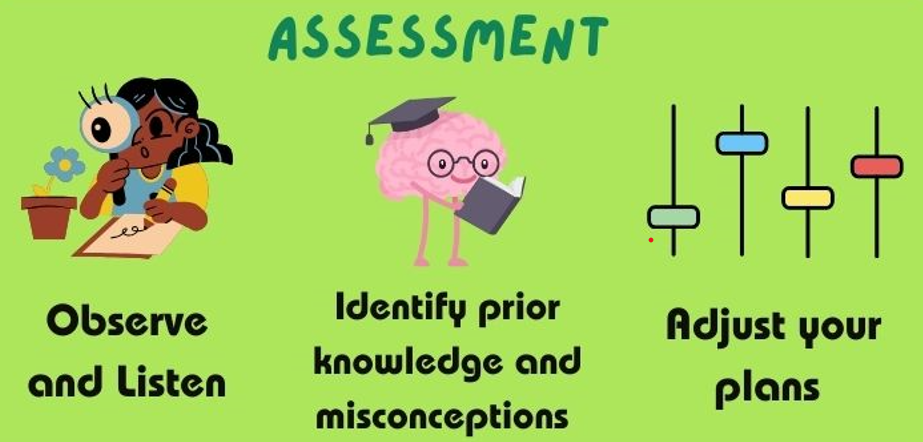
Weaving Assessment With Provocations:
- During the provocation phase, pay close attention to students’ reactions, comments, and levels of engagement.
- Listen carefully to their discussions and note their initial thoughts, questions, and any misconceptions.
- Collect this data through notes, recordings, or student work samples. This information will be invaluable for assessing their understanding and planning subsequent lessons.
Classroom examples:
Early Years (Concept: Living Things)
Guiding Question: What do you notice about these different plants and seeds?
Provocation: Bring in soil, seeds, and small plants. Let the children explore these materials, encouraging them to touch, smell, and observe. This sensory experience can provoke questions about plants, their needs, growth processes, and the environment, aligning with a unit about living things and their relationships with each other and the planet.
As the students explore the materials, listen to their thinking, ask them questions and create an opportunity that allows them to converse about their observations.
Second Grade (Concept: Measurement)
Visible Thinking Routine: “Think, Puzzle, Explore”
Provocation: Set up various stations with items of different lengths (e.g., a collection of sticks, ribbons, and blocks). Ask students to use the materials to measure various items in the classroom and the playground then compare notes. This hands-on activity encourages students to think about length, compare sizes, and introduces concepts of measurement in a tangible way.
\Hand out a template of the thinking routine and encourage students to share their observations and questions as they explore the materials.
Third Grade (Concept: Technology)
Visible Thinking Routine: “3-2-1 Bridge”
3 Thoughts: Share three thoughts about the technology you’re observing.
2 Questions: What two questions do you have about these technologies?
1 Analogy/Simile: Make an analogy or simile about the evolution of technology.
Provocation: Present a collection of artifacts from different eras (e.g., a vinyl record, a cassette tape, a CD, and a USB stick). Allow students to explore these items and discuss what they are, their uses, and what they might tell us about changes in technology over time. This can spark an inquiry into historical changes and how they affect our lives.
To wrap up, using provocations in the classroom is about more than just grabbing students’ attention. It’s a strategic way to kick off their thinking and get them to connect with the material on a deeper level. As teachers, it’s our job to pick the right provocations and use what we learn from them to steer our lessons.
Looking to go deeper with this in your school? I offer coaching and workshops for teams and curriculum leaders. [Learn more here.]


 The Organized Chaos In The PYP Classroom
Leave a Reply