If you’re in the PYP world like me, you’re probably familiar with the idea of encouraging our students to self-assess their learning. The Enhanced PYP, updated in 2018, nudged us to take it a step further by adding self-adjustment into the mix. In ‘From Principles to Practice,’ the IB outlines what makes an educator assessment-capable. By teaching our students how to self-adjust, we’re helping them become assessment-capable learners themselves.

So what exactly is self-adjustment? And, more importantly, how can we set our students up to do it successfully?
What Is Self-Adjustment?
Let’s start by breaking it down. Self-assessment is when students look back on what they’ve learned and measure their understanding. It’s reflection, pure and simple.
Self-adjustment goes a step beyond. It’s not just looking back; it’s also looking forward. Students not only identify their strengths and weaknesses but also make changes in real time to improve.
Why Is It Important?
Self-adjustment fosters independence and builds problem-solving skills. Instead of waiting for feedback, students are empowered to recognize their own mistakes and correct course as they go along. It empowers student agency as it gives them ownership of their learning.
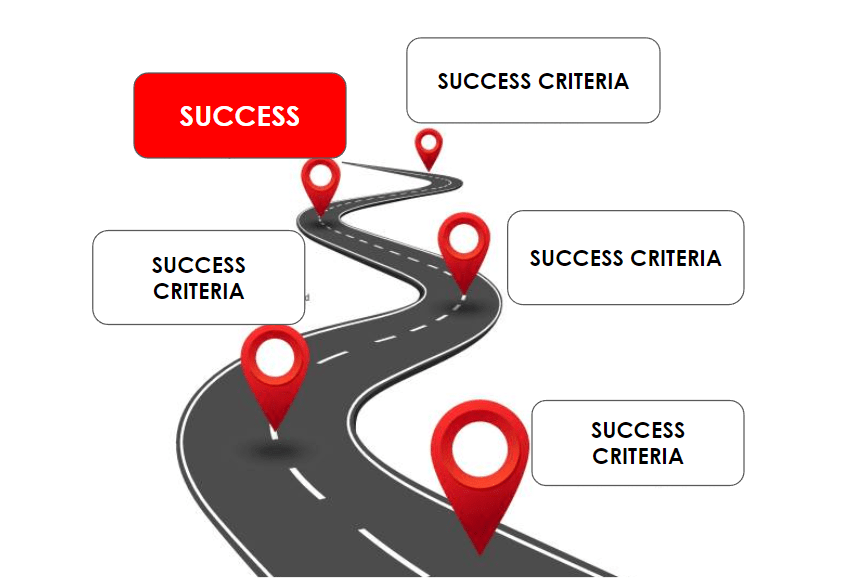
The Role of Success Criteria in Self-Adjustment
What is Success Criteria?
Before diving into the how-to, let’s first understand what success criteria actually are. In simple terms, success criteria are specific, measurable, and clear goals that lay out what success looks like for a task or project. They’re like the GPS for your students, showing them the way from “I’m not sure what to do” to “I totally nailed this!”
Here are some examples of success criteria:
Math – Early Years
Success Criteria:
- I can count objects in a set, up to 10.
- I can match the number of objects to the correct numeral.
- I can use counting to solve simple problems, like ‘2 apples + 1 apple’.
Writing – Lower Elementary
Success Criteria:
- My sentence has a subject and a verb.
- My sentence expresses a clear idea or action.
- I can use descriptive words to add details.
Science – Upper Elementary
Success Criteria:
- I can identify the three states of matter: solid, liquid, and gas.
- I can explain how temperature affects states of matter.
- I can demonstrate the transition between at least two states of matter.
Why are success criteria so valuable in the classroom?
So, why bother with success criteria?
Well, for starters, they remove ambiguity. When we spell out what success looks like, students aren’t left wondering what’s expected of them. This saves time and energy that can be better spent on learning.
Secondly, success criteria provide a self-check tool that students can use independently. Knowing the criteria lets students be their own judges, spotting mistakes and fixing them. This promotes self-adjustment and takes some of the burden off the teacher for constant monitoring.
In a nutshell, success criteria make the learning goals crystal clear for students, which in turn, makes it easier for them to self-assess and self-adjust effectively.
This is how it looks in practice …
Math – Early Years
Task: Count objects in three different sets and then match those numbers to the corresponding numerals.
Self-Assessment: Place a card with the numeral next to each set. Step back and see if the numbers and sets align.
Self-Adjustment: If there are any mismatches, correct them by recounting the objects.
Learning Goal: Count up to 10 objects by myself and match them with the right number.
Writing
Task: Write a sentence describing what you did over the weekend.
Self-Assessment: Read your sentence out loud and use colored markers to underline the subject in blue, the verb in red, and the adjectives in green. Ask yourself, “Does it sound like a complete thought? Is it detailed?”
Self-Adjustment: Use descriptive words to add details to your sentence.
Learning Goal: I want to be able to use adjectives to add details to my sentence.
Science
Task: Conduct an experiment to demonstrate the transition between at least two states of matter.
Self-Assessment: Film the experiment and review the footage to see if you accurately demonstrated and explained the transitions between the states of matter.
Self-Adjustment: Use your notes to edit or add to the sections of your presentation that were not clear or missed a point.
Learning Goal: I want to accurately explain how temperature changes cause matter to transition between states.
Your Roadmap to Promote Self-Adjustment in the Classroom
So, you’ve read about the ‘why’ and the ‘what’ of self-adjustment and success criteria. Now, let’s get down to the ‘how.’ Here’s your roadmap for implementing these key components in your classroom.
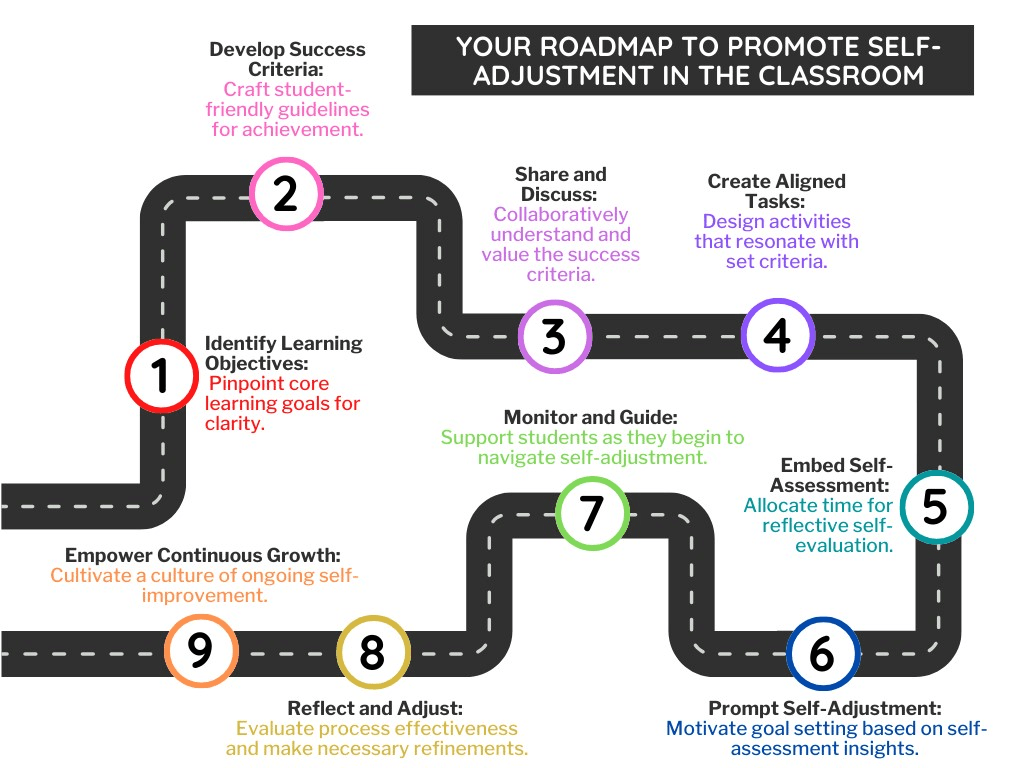
Follow these steps to guide your students towards becoming more self-adjusting, empowered learners.
- Identify the Learning Objectives: Before anything else, you need to be clear about what you want the students to learn. What’s the bigger picture?
- Develop Success Criteria: Translate these objectives into student-friendly language. Remember, they’re supposed to be the GPS guiding the kids, so make them clear and specific.
- Share and Discuss: Don’t just hand out a list. Discuss the success criteria with your class. Make sure everyone understands what they mean and why they’re important.
- Create Tasks that Align: Design your classroom tasks and assessments so they directly relate to the success criteria. This ensures a smooth road for the kids to follow.
- Embed Self-Assessment: After tasks are completed, allow time for students to self-assess. Use a variety of methods – written reflections, peer discussions, or simple checklists.
- Prompt Self-Adjustment: Encourage students to review their self-assessment and set new learning goals based on their observations. This can be done as a class, in small groups, or individually.
- Monitor and Guide: Initially, you’ll need to closely monitor how students are managing self-assessment and self-adjustment. Provide support, mini-lessons, or additional resources as needed.
- Reflect and Adjust: Finally, take some time to reflect on how it’s going. What’s working? What’s not? Adjust your approach and keep refining.
By following these steps, you’re not just teaching your students the curriculum. You’re teaching them how to learn, how to adapt, and how to pave their own way towards success.
Visit this Padlet to learn more about developing assessment-capable students: https://padlet.com/sohaoak86/assessment-becoming-assessment-capable-bxjqo0lpib5w2f4f
Interested in taking your teaching practices to the next level? If you’d like to explore these ideas further or get personalized support, feel free to reach out and book a coaching call with me! Contact me on LinkedIn or use this link (https://theorganizedchaosinthepypclassroom.com/contact/)


 The Organized Chaos In The PYP Classroom
Leave a Reply