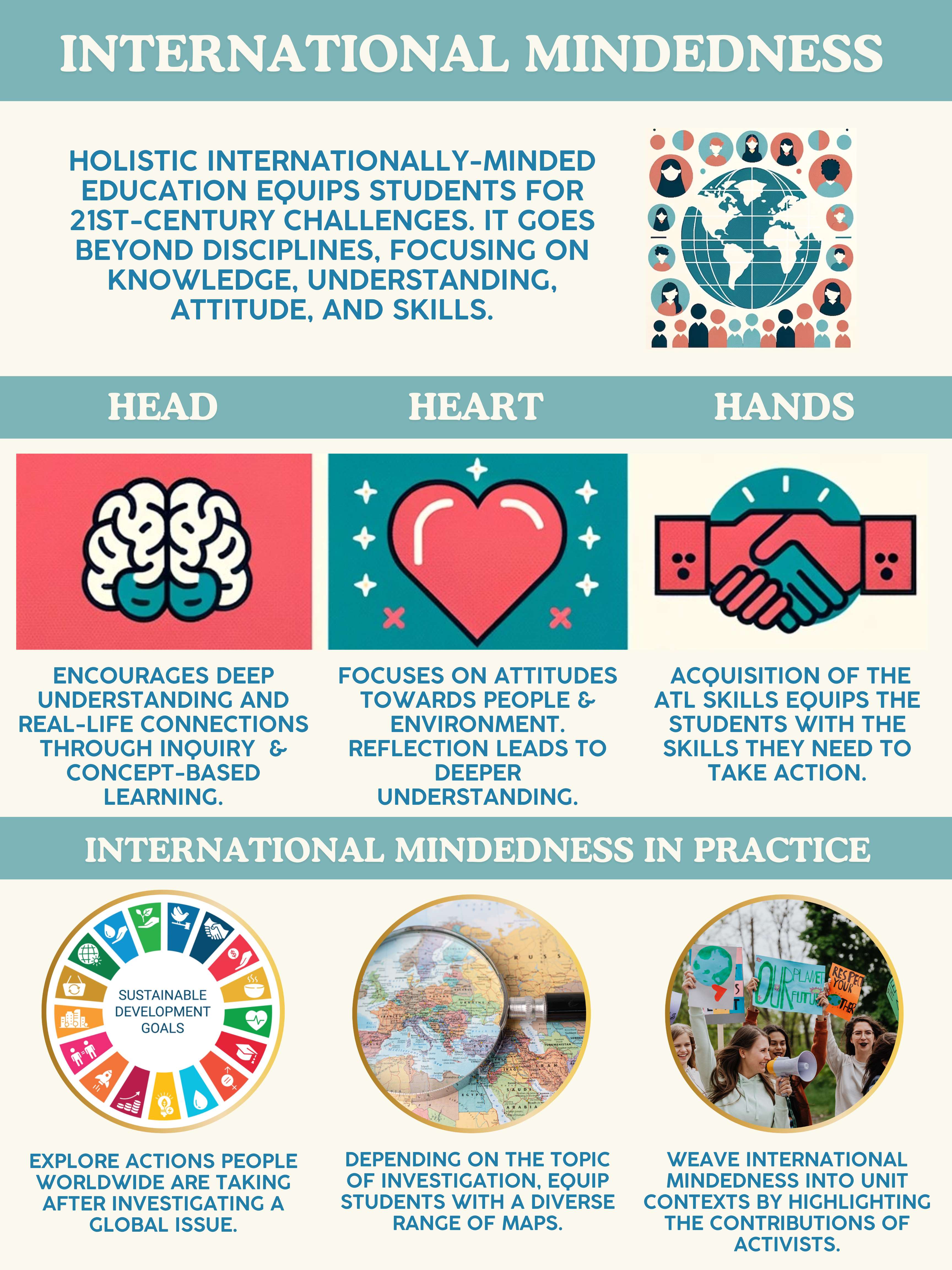
As an IB educator, I consistently emphasize the importance of introducing students to various cultures and perspectives within each unit. While it can be challenging to discover ideas that align with the inquiry contexts dictated by the themes, I’ve listed some of the strategies we’ve employed in classrooms from kindergarten through to grade 5 below.
- Global Issues:
When planning a unit, we often begin with a problem or global issue to capture the students’ interest, leading them to ask questions that guide the direction of the unit. For instance, in Grade 3, when students were exploring body systems under the theme “Who We Are,” teachers introduced the topic of Malaria and its impact on people’s lives in Africa. The questions posed by the students then directed the teachers to facilitate inquiries into various body systems.
- UN Goals:
A great approach is to enable students to explore actions people worldwide are taking after investigating a global issue.
- Maps:
In every classroom, we proudly display a map! Both teachers and students frequently reference these maps, whether to pinpoint a country, identify where public figures live, or delve into the geography of specific regions. Depending on the topic of investigation, we equip our students with a diverse range of maps. For instance, when studying landforms, topographic maps are brought into play. When the focus is on country borders, political maps are utilized. While our Grade 4 students were exploring the topic of ‘World Economy’ under the ‘How We Organize Ourselves’ theme, they explored resource maps to discover the variety of resources produced across countries. Additionally, for more data-driven topics, we use statistical maps that visually represent various statistics.
- Activists:
An effective approach to infusing international mindedness into various unit contexts is by highlighting the contributions of activists. Simply choose an activist who made a significant impact in the context of your study. For instance, consider referencing Gandhi when discussing peace, Newton in science contexts, Harrison Ford for economic insights, or Jadav for environmental topics. Students can delve into the histories of these figures, gaining a deeper understanding of their motivations and the impacts they made globally.
These strategies help our students reflect and deeply understand the learner profile attributes and what it means to be an internationally minded person. They also help them see the learner profile in action.
Looking to go deeper with this in your school? I offer coaching and workshops for teams and curriculum leaders. [Learn more here.]


 The Organized Chaos In The PYP Classroom
Leave a Reply